Thursday, January 24, 2013

Housing Stability and Academic Success

I want to tell you about a local project with which I am enormously impressed.  I have played no part in it, but have come to admire the project, the public body that initiated it, and the very impressive initial evaluation findings.  I see organizations like the sponsor of this project as very desirable places where Community Psychologists can make meaningful contributions as employees or consultants.

Let’s start with the organization’s Mission, Vision, and Values statements, adopted in 2008: Tacoma Housing Authority (THA) “provides high quality, stable and sustainable housing and supportive services to people in need.  It does this in ways that help them to become self-sufficient, that strengthen communities and that use its public and private resources efficiently and effectively.”  THA envisions “a future where everyone has an affordable, safe and nurturing home, where neighbourhoods are attractive places to live, work, attend school, shop and play, and where everyone has the support they need to succeed as parents, students, wage earners and neighbours.”  Stated Values include Service, Integrity, Stewardship, Communication, Diversity of Staff, Collegial Support and Respect, and Excellence.  THA wants its services to be temporary, transformational, and to help families prosper.

Please see www.tacomahousing.org for a comprehensive view of all THA activities and services.

In its commitment to help students who live in its public housing succeed, THA initiated a Special Housing Program within the service area of McCarver Elementary School, a school with an extraordinarily high student turnover rate in a neighbourhood generating many social indicators of distress.  Many housing authorities provide student resident with homework help and mentors, but THA realized that neither students nor the school could succeed when burdened by such high turnover rates.  In 2011, the year before this project started, 97 % of McCarver students changed during the school year.  A few years before, turnover rate had reached 179%.  THA administrators recognized that children whose lives are disrupted by changing schools so often have a lot of difficulty learning, and their teachers have great difficulty teaching effectively with so many students coming and going.

THA administrators realized that stabilizing family housing would be a key to both student and family success.  Michael Mirra, Executive Director, sees THA’s role as more than landlords, property managers, and real estate developers.  He comments that THA gives vouchers in order to have families remain in place, rather than to escape to other neighbourhoods and then be replaced by other families facing the same challenges.  He also points out that desirable schools draw families and enhance their neighborhoods.

Beginning in the fall of 2011, THA began providing up to 5 years of rental support to up to 50 previously homeless families with children enrolled in kindergarten, 1st of 2nd grade.  These students constitute about 20% of the school’s student body.  During the first year, parents were required to pay rent of $25 a month.  Each subsequent year, they pay an increasing 20% of the rent per year, until they are able to pay 100% after the fifth year.

In return parents had to agree to five conditions:
1. Keep their child enrolled at McCarver;
2. Be very involved with school activities and their child’s education;
3. Work on their own career and financial growth;
4. Work with THA staff to accomplish these goals; and
5. Share data on their child’s progress in school and the parents’ economic development.

To help parents support their child’s education and also become financially independent, THA:
1. Assigned two full time case workers to provide the families with support and resources;
2. Involved over 30 community partners who provide families with services to combat chemical dependence and family violence; and provide parent skills classes, workforce training, and adult education.
3. Sponsors monthly parenting meetings.
4. Requires parents to participate in PTA and other school events.
5. Makes it possible for the children in the program to attend spring break and summer camps, to extend their learning opportunities.

This project is funded primarily with THA ordinary income.  The Bill & Melinda Gates Foundation is supporting a portion of salary for THA’s Manager of Educational Programs and is funding a comprehensive outside evaluation of results.

Results:

Tacoma School District has embraced this initiative in several ways.  McCarver teachers report that they are able to teach more effectively because they have the same students every day, get to know them and meet their learning needs.  The staff has supported unanimously a School District decision to implement the Primary Years International Baccalaureate, a school-wide program that will enrich education for all McCarver students.  In addition to that financial investment, the School District has invested in additional staff development opportunities.  It is collaborating with THA at other schools having significant enrolment of students from families housed by THA.

GEO Education and Research is conducting the project evaluation.  While cautioning that no firm conclusions may be drawn yet, the trends are moving in desired directions:

“A long term analysis of multiple years will be required to determine if desired outcomes are being achieved and sustained.  Program planners and managers did not expect to see measurable, much less significant, changes in student performance in the first year of implementation.  Given the traumas and challenges experienced by the students and their parents, rapid change seemed unlikely.  Yet, our analysis has shown that in one primary indicator of student success – reading – Program students (especially those in grades K-2) made substantial strides during the first year of the program.  In addition, attendance was positively and significantly correlated with these increases in DIBELS (reading) scores.  There was also a decline in the overall mobility rate a McCarver, from 107% in 2010-2011 to 96.6% in 2011-2012.  Program student mobility was 4.5% while the mobility rate of the rest of the student population was 114%.  Mobility rates are highly variable year to year, but this indicator is moving in the right direction.

For more information about this program, contact Michael Power, PhD.  (in Educational Psychology) Manager of Educational Programs: 253.207.4404  mpower@tacomahousing.org

DISCUSSION

On January 2, 2013, I met with Michael Mirra, Executive Director; Nancy Vignec, Director of Community Services; and Michael Power, Manager of Educational Programs to learn more about the McCarver Elementary Special Housing Program and to ask what of the Community Psychology Competencies might be valued by a public housing authority.  Each was very helpful and I thank them for meeting with me.  Throughout the discussion, they returned again and again to the THA Board’s foundational Vision, Mission, and Values statements.  They clarified how this project springs from an increasingly clear understanding that safe, affordable, and stable housing under-girds family, student, and school system success.  They reported that, in addition to the student outcomes described above, participating parents’ earned income had increased 35% during the current evaluation period and parents are much more engaged in both student success at school and their own improvement plans.

The THA program began when there were no models to follow, and they have had to feel their way along as it developed.  One of their early steps was to hire an Education Manager who had been a key administrator in Tacoma School District; thereby strengthening the linkages between housing authority and school district.  Now, seven other housing authorities across the nation have added Education Managers.  A number of housing authorities from around the nation have visited to learn about the program, as has an Assistant Secretary of HUD.  It is pretty clear that this type of project will spread to other housing authorities.

THA authorities see THA as community developers; in addition to their traditional roles as landlords, property managers, and property developers.  They point out that many people choose where to live based upon the quality of the neighborhood’s schools, when they have choice.  People who have resources will tend to migrate away from neighborhoods with poor schools, leaving behind those who lack resources and thereby contributing to neighborhood decline.  That is why merely providing housing vouchers alone cannot generate neighborhood improvement.  THA hopes that stabilizing McCarver Elementary and introducing a strong curriculum taught by faculty with high expectations will contribute to stabilization of the Hilltop Neighborhood of Tacoma, by enabling families to remain in housing and by drawing new families to a desirable neighborhood.

I asked Michael Power to look over the CP Competencies list and tell me whether these skill sets might be desirable to public housing authorities around the nation.  He answered very positively.  I suggest that Community Psychologists might want to get acquainted with their local housing authorities and with other community development organizations.

Al Ratcliffe, Ph.D
Community Psychologist
Tacoma, Washington, USA

Thursday, December 6, 2012

Community Practice in the Age of the Data Scientist

Data is hot. Seriously. The Harvard Business Review has (perhaps a bit wryly) declared Data Scientist to be the sexiest job of the 21st century. Everyone from the New York Times to the White House blog has chimed in about how Big Data is changing the world.
Nate Silver: Sexiest man alive? 

What is Big Data and why is it such a Big Deal? The answers to those questions are long and varied, but I'll attempt to give the cliffs notes version.

(1) Data is being generated at an exponential rate.
In a remark that's often quoted in pieces on information overload, Google's ex-CEO Eric Schmidt famously alleged that we generate as much information in 2 days than we did from the dawn of humanity until 2003. Much of this data comes from new technologies (e.g. social media, GPS, online video)

(2) Data can be shared, combined, and analyzed at an unprecedented level.
The kind of information that may have once resided in file folders (think Data.gov) or later in Excel spreadsheets can now be shared online and merged with other data sets to form new frankendatasets.

Clearly, there's a lot of potential for social good. Data about health, the environment, and community well-being can be used to make informed decisions about all manner of activities. Recognizing that this is the case, but that many organizations working for social good may not possess the skills necessary to take advantage of this, groups of civic-minded data scientists have formed. This includes Statistics without Borders, which is run by the American Statistical Association, and Data Kind, which organizes events they call Data Dives and is developing a Data Corp for volunteers (and totally deserves its own blog post).
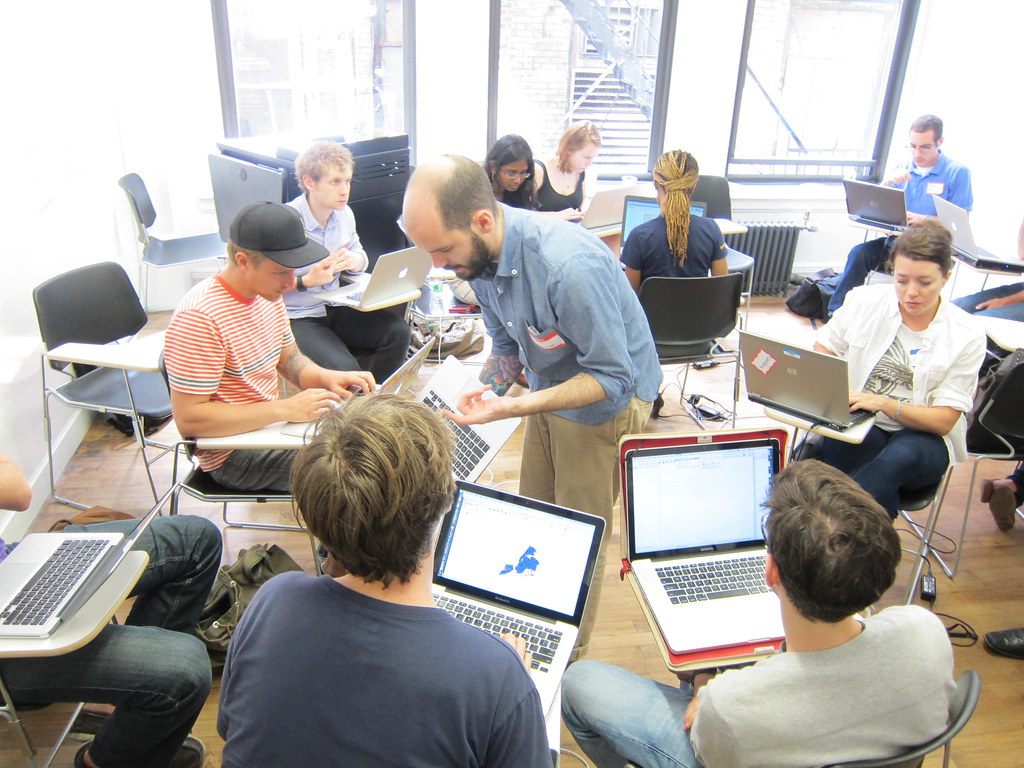
DataKind's awesome volunteers help NYC parks

Of course, there are potential downsides to the hype surrounding Big Data. As noted by Oxford research fellow Mark Graham, the availability of vast quantities of data from certain sources may lead us to focus our research on a skewed and self-selected segment of the population. Furthermore, the analysis of large sets of merged decontextualized data can blind us to the reality of our diverse social world, in which everything exists in its own unique cultural context.

It's here that Community Psychology Practitioners really have a chance to offer something that's needed. Though we don't typically work with petabytes of data, most of us can be considered to be trained data scientists - capable not only of running analyses but of generating useful research questions and designing predictive models that help us make the most out of data. However, our fundamental values ensure that we don't reduce people to statistics. The Society for Community Research and Action's first principle is respect for diversity among peoples and settings, while the second asserts that people are best understood within their contexts. 

Qualitative analytical methods, beyond mere computer-automated parsing of text, allows for research to be conducted in a way that respects the diverse and idiosyncratic. And what are humans if not diverse and idiosyncratic?

More fundamentally, Community Psychology Practitioners are committed to collaborating with community members. Though we certainly do our fair share of number crunching (watch out for an upcoming post on publicly available sources of data relevant to community work), we know that even the most adept data scientist cannot sit behind a computer and dictate what changes should be made in a community. No matter how sophisticated your analyses, you can only truly foster community growth when you connect with actual community members. When it comes to people, we are the experts on our own experience.

Gina Cardazone, M.A.
University of Hawai`i, Mānoa

Tuesday, November 27, 2012

Will you be the next CPP blog coordinator?

Are you a fan of the Community Psychology Practice blog? Do you enjoy blogging or want to learn more about it? Are you interested in connecting with other community psychology practitioners? If your answers are yes, you may be just the person we're looking for!

The Community Psychology Practice blog is looking for a new volunteer  blog coordinator. As coordinator, you are not expected to write all of the blog posts, though you are welcome to be a writer as well. Here is what you will do as "coordinator": 


  • Recruit community psychology practitioners to write blog posts 
  • Keep a blog schedule, ensuring that the blog has new content every week, and remind bloggers when it's their turn to post

  • Check comments and engage people in conversations 
  • Look for opportunities to share stories and connect with others online who may be interested in CPP
Here is what we're looking for in a blog coordinator: 
  • High motivation/interest/enthusiasm about the CPP blog 
  • Dedication to the values of community psychology practice
  • Willingness to make an ongoing commitment to make sure there are at least 1-2 blog posts per week
You do NOT have to have experience in social media, or be a writer, in order to do this! There are a few of us who have been involved with this blog for the last few years, and we're happy to act as advisors, and help you to recruit new writers.

If you think you may be the right person for this role, lease email compsychpractice@gmail.com with some information about you and why you're interested in doing this. Also please feel free to ask any questions, and do pass this along to anyone you think may be a good candidate for this! 

Wednesday, November 14, 2012

Psychology for a Better World

Sure, the social sciences have finally been recognized as a means to help win political campaigns. But have they been truly appreciated for their potential to build a healthier, happier, more sustainable world?

Psychology for a Better World: Strategies for Sustainability  draws from academic disciplines including community psychology and positive psychology, and is (as they put it) "jam packed with action strategies." The Global Journal of Community Psychology Practice (GJCPP) has a full review of the book which includes chapters such as " Positive emotions and flow: Encouraging creativity and commitment," "Morality and cooperation: Making the most of our desire to be good," and "A self-help guide for sustainability advocates."

Hard copies of the book are available to order from their site for $15, and Kindle copies can be purchased from Amazon for only $2.99. The authors also offer a free PDF download of the book from their website. That's truly in the spirit of building a better world.


Psychology for a Better World website: http://www.psych.auckland.ac.nz/uoa/home/about/our-staff/academic-staff/niki-harr%C3%A9/psychologyforabetterworld

Global Journal of Community Psychology Practice (GJCPP), free open access journal: http://www.gjcpp.org/

Post adapted from GJCPP book review by Judah Viola


Thursday, November 8, 2012

Community Organizing and the 2012 Elections

Before November 6th, one of the big stories of the 2012 U.S. election season was the potential influence of millionaire-funded Super PACs. The unrestricted influx of money from wealthy individuals and corporate donors to supposedly independent political action committees seemed like the big X factor in this election. Yet, while money certainly played an undeniable role in this election, there was another crucial factor whose importance was barely mentioned until Tuesday night: community organizing. 

Of course, political pundits didn't actually call it community organizing, they called it Obama's "ground game." But the fact is that the Obama campaigns approach, which at times entailed reaching out to barbershops and churches throughout battleground states, clearly hearkens back to his early days as a community organizer. The success of the "ground game" was as undeniable as it was unexpected, at least by the opposing political party. Projections that showed Obama losing typically assumed that the Democratic base would be less motivated to turn out in 2012, and counted especially on the false assumption that the large turnout among minority voters in 2008 was just a one-time occurrence. 

Yet the results showed just the opposite: the number of African-American voters in the hotly contested state of Ohio actually increased, making up 15% of the voting electorate in 2012 vs. 11% in 2008. Though the effects of big money and TV ads could not be denied, it may have been one party's superior ability to reach out at the community level that proved decisive in this election. This is good news for community psychology practitioners. And if this ability to effectively mobilize communities to take action for the common good can continue beyond the election season, it's even better news for the country. 

Wednesday, October 24, 2012

7 Tools and Techniques for Making Grad School Easier

Namesake of the pomodoro technique.
Recently, I wrote a long email to a friend who'd just entered graduate school, chock full of advice on things that have helped me get through school over the years. And I realized (1) Wow, I've been in school for a long time, and (2) Hey, this information may actually be useful for other people.

While there are plenty of big-picture topics that are worth addressing (e.g. work-life balance, setting yourself up for your career after school), this post is about the nitty-gritty tools and techniques that I've found useful in  accomplishing the major tasks of grad school - namely reading, writing, and research.

1. Zotero: A lifesaver. This reference management software allows you to keep track of all your reading, along with notes and tags, and automatically insert citations and generate bibliographies. There are plenty of other tools (e.g. End Note) that help you can do this, but Zotero is extra awesome because it's free (at least up to 100MB), allows you to share your libraries, and is constantly improving. There are plenty of others, but the important thing is to begin using a reference management system as soon as possible. Because you will be reading many many things.  Mendeley and Papers 2 (which integrates reference management into paper writing) come highly recommended by others.

2. The pomodoro technique : Alternating periods of hard focus with breaks. Sounds simple, no? But beginning each chunk of work with an end in mind can really improve productivity.

3. Freedom: This keeps you from going online for specified periods of time. Sure, you can do this other ways, but this is by far the simplest. It's not free, but it's only $10 and is well worth it.  I've found this to be particularly effective in combination with the pomodoro technique - I set my computer to be offline for 25 minutes, and when I get notified that my time is up, I know it's time for a 5 minute break.

4. 750words.com: Journal writing is hardly a new idea, but 750 words is an awesome and fun tool for daily brain dumps, which can help not only to clear your mind each day, but also make writing easier. Some people have no fear of the blank page, but for those who do, this can really help with that.

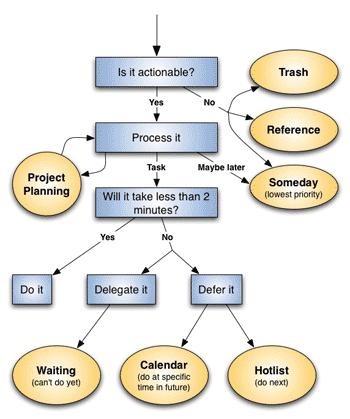
5. GTD: Getting Things Done is a book and a productivity system that I was introduced to years ago when I worked in the tech sector (it was pretty huge among geeks in the early aughts). While I don't follow the full system, and think some aspects of it are cumbersome, there are several GTD concepts/techniques that I consider essential, especially when there are way to many things to get done.
Surrounded by stacks of papers? GTD can help.
  • Next Actions : Get rid of abstract todo items that invite procrastination, and replace them with projects and concrete Next Actions. Probably the most powerful concept in the GTD system. 
  • Inbox to zero : Process email instead of just reading it, and always strive to get your inbox to empty. Create a separate action folder for things that require more time, and check that regularly.
  • Simple filing system: Create a new folder even if you only have 1 item to put into it, get rid of hanging file folders and categories, alphabetize everything, and use a nice label maker so you can find things. Because if it takes you more than a few seconds to file something, you won't do it. 
  • 2 minute rule : If it can be done in less than 2 minutes, do it now. 

6.  The Single System: I was only recently introduced to this in a great book called "Demystifying dissertation writing," but I wish I had read it my first year. This is particularly helpful for those with fear of the blank page, or those who struggle with writing lit reviews. It provides a logical system for getting through your readings, taking notes, and turning it all into a coherent final product.

7.  The DissCo: If you're like me, you thrive on variety, a fast-paced work environment, and teamwork. In which case...I'm sorry. Because that is not what grad school is about. It's a long and sometimes lonely road, especially when it comes to the major PhD hurdles: thesis, comprehensive/qualifying exams, and dissertation. Though these are ultimately hurdles you have to jump yourself, you can still create a sense of teamwork and community by meeting with other students.  I do this with others, and we call it The DissCo - for Thesis Dissertation and Comps. You can schedule regular times to meet and include goal setting and reviews, or just meet informally and work side by side. Because what sounds better -  "I'm going to sit next to people while staring at my laptop for 9 hours" or "I'm going to The DissCo"?

Of course, no technique will help you if you're not sure why you're in school, if you're too distracted by other pursuits to make it a priority, or if you're not willing to put in countless hours of hard work. But if these conditions are met, productivity tools and techniques can make life and work way easier. I'm sure there are tons of other suggestions that other people have - including current grad students and those who've survived it - so please share them in the comments!


Gina Cardazone, M.A.
University of Hawai`i, Mānoa


Wednesday, October 17, 2012

Communal Thriving: Pursuing Meaning, Justice, and Well Being

How can we help communities thrive? This is the question being addressed by the The Society for Community Research and Action (SCRA), which will be holding its 14th Biennial Conference next summer in Miami.

Want to know more about this topic, or have something to share with others? SCRA will be accepting proposals for sessions starting at the end of this month, and continuing through December 10th.

Proposals that emphasize participatory processes for sharing their ideas will be favored. There are six tracks, which are focused on communal thriving through:


  1. Community partnerships and social change
  2. Prevention and wellness promotion 
  3. Narrative, arts, and new media
  4. Equity, diversity, and social justice
  5. Research 
  6. Organizational and school transformation 


To submit a proposal, please visit http://www.scra27.org/biennial and select the “submit your proposal” link and follow the instructions. The All-Academic system will be ready to accept proposals on or about October 30th, 2012. The deadline for receipt of program proposals is: 11:55 PM (EST), Monday December 10th, 2012.