Showing posts with label THEory into ACTion. Show all posts

Wednesday, February 17, 2016

It Takes a Village: Project Planning for Two-Generation Services in an Underserved South Carolina Community

THEory into ACTion

A Bulletin of New Developments in Community Psychology Practice
February, 2016

by
Amanda M. McDougald Scott, MS
Nicholtown Child and Family Collaborative Project Coordinator,
PhD Student at Clemson University, Institute for Family and Neighborhood Life


      The Nicholtown Child and Family Collaborative project aims to create a community-based, two-generation community center in a high-needs area of Greenville, South Carolina, known as Nicholtown. This paper provides an outline of the steps taken to achieve progress towards this purpose, as well as recommendations and lessons learned for others who wish to execute similar projects.

Overview of Nicholtown Child and Family Collaborative (NCFC) Purpose
NCFC was established to provide services for the children and families of Nicholtown to improve child outcomes; provide parent training, education, and employment; and build lasting community infrastructure (1, 2). The project will include a two-generation model, a standard that has been used by Head Start and other welfare reform programs since the 1980s and 1990s (3-5). It has been noted that two-generation programs share 3 important features: 1) a developmentally appropriate early childhood program, 2) a parenting education component, and 3) an adult education, literacy, or job skills and training component (6).

Methods and Procedure
Why Nicholtown?
            The City of Greenville laid out a Neighborhood Plan in 2011, which included a Master Plan for Nicholtown, an urban neighborhood encompassing 390 acres in the heart of Greenville (7). The Master Plan for Nicholtown was an indicator of long-standing interest in revitalizing the historic neighborhood. Nicholtown community members had been pleased with the housing progress in their neighborhood, but were disgruntled by the inattention to their children and community. They wanted a school and community center that would provide resources for their children and families. Therefore, after demolition and reconstruction of low-income housing had been completed (the first step of the Master Plan), the next step was to provide for the children and families of Nicholtown.

Setting up the Collaborative          

Identification and recruitment of stakeholders. Chandra Dillard, a South Carolina State Representative, began work on assembling the Collaborative in 2012, shortly after the first housing revitalization steps of the Nicholtown Master Plan were complete. She heard the needs of her community, and first sought to rectify the situation by approaching the executive director of SHARE/Head Start in Greenville County. SHARE/Head Start was the first contact due to the fact that the housing phase of the Master Plan had inadvertently eradicated and not relocated the former location of Head Start in Nicholtown. Head Start was in favor of building a new early learning facility for its return to Nicholtown, and advised the Nicholtown Representatives to start a collaborative of professionals who could properly research and fundraise for this effort.
The next step was to approach organizations with vested interests in children, families, communities, and education. Greenville community leaders with success in projects like NCFC’s, people who could guide best practices and outcomes, and Nicholtown community members and leadership were invited to join the NCFC. Current stakeholders include local healthcare providers; community finance leadership; local, city, state and federal organizations with interest in children and families; elected officials (community, city, state); attorneys; Nicholtown community members; local universities; the Nicholtown Neighborhood Association; Nicholtown community centers; marketing professionals; and construction professionals. The most recent estimated number of NCFC members (as of January 2016) was 36, including the Project Coordinator and Collaborative Chair.

Collaborative’s first steps. May 2014, a consultant was hired to begin work on a sustainable strategy for moving forward with the NCFC Project. Once the assessment of Nicholtown and the Greenville community was complete, a final presentation was given to the Nicholtown Early Learning Collaborative and its Stakeholders. Several useful documents were generated to guide progress, including the “Nicholtown Early Learning Collaborative (now NCFC) Recommendations” (1).
            Recommendations were soon acted upon following the consultant’s final analysis for NCFC progress, including organization and structure; volunteer committees to address different aspects of the work; and hiring a project coordinator. The project coordinator
·         assessed materials provided by the United Way of Greenville.
·         worked towards gathering data and tools used by the consultant and other research/analyst and nonprofit entities to understand the work that had been previously done, and determine the best way forward in executing the NCFC recommendations and plan.
·         met with the consultants to receive data, learn more about the methods and process for data collection, and hear feedback about the project and its direction.
·         met with Collaborative members, Chairs of each existing committee, as well as “priority” people involved with the Collaborative.
·         met with Head Start leadership, as this was clearly a direction that the NCFC recommendations and key Collaborative members were in agreement that the NCFC project should go.
·         placed high priority on forming strong relationships with leadership at the recommended site for NCFC programs and progress.
·         sought relationships with other non-profits working in the neighborhood to understand what other services were being provided (or not) in the area.
·         began attending monthly Nicholtown Neighborhood Association meetings to boost face recognition and relationships with the Nicholtown residents and community.
·         referred back to the recommendations provided by the consultant, as well as the data from the community (1) to explore potential partners missing from the NCFC. High priority was placed on finding resources that could be placed in Nicholtown to serve both the community and NCFC goals for no cost to NCFC.  
Community Engagement Events
A community engagement event was held in late 2015; at least 33 adults and 25 children from the Nicholtown community attended and participated. NCFC leadership shared progress and gathered feedback on the project, as a result of the survey data that was collected from them. The purpose of this event was to involve the Nicholtown community in the NCFC process as active participants in the project.

Implementing Existing Greenville Resources into Nicholtown
Leadership from a local healthcare system, NCFC, and leadership from the identified Nicholtown community empowerment site met to discuss potential partnerships. The Greenville Health System will provide a mobile clinic at least once a month that will be parked at the community hub. Furthermore, discussions between a service for young children who have special developmental needs, the NCFC, and the mobile clinic have initiated interest in bringing services to Nicholtown. Additionally, discussions with the Department of Health and Environmental Control (DHEC) have indicated that there is interest in returning to Nicholtown to facilitate health needs for families and children.

Trips to Visit Similar Projects
The ultimate goal of the NCFC, supported by the Nicholtown Master Plan and the recommendations from the consultant (1, 8), is to create a two-generation community empowerment center. The community empowerment center will place heavy emphasis on early learning, but will also offer support to children and their families as children grow. Therefore, with these goals in mind, we decided to visit other successful projects both in the South Carolina Upstate and the Southeastern U.S. in order to learn from their achievements and pitfalls. Lessons learned from each visit were reported and discussed at NCFC meetings.

Findings and Lessons Learned      
Continuing the work and momentum generated thus far for the NCFC will require several factors, first and foremost being financial resources. It is difficult to do work on such a large scale without paid employees, and it is quite impressive that the NCFC has been able to come as far as it has with limited financial resources. This indicates that there is interest among stakeholders for this project to succeed; since this is a project that engages the Nicholtown community, there is also interest in the project’s success from the community perspective. In order to continue this trajectory, aside from financial resources, the thoughtful and deliberate recommendations set forth by the consultant should continue to be followed. Furthermore, Israel’s (9, 10) and Holden’s (11) guidelines for successful community engagement work should be followed. Below is a brief list of other findings and lessons learned:

Data Reviews
·      Reviews of the data collected by the consultant indicate that there is interest both within Nicholtown, and in the greater Greenville community in the NCFC project and its goals, including stakeholders who are already involved in NCFC, entities who would potentially provide financial support, and the Nicholtown community members/residents (1).
Stakeholders
·         Each person comes to the project with her own agenda. This can make achieving the goals of the NCFC challenging at times, requiring strong leadership, communication, and negotiation. The group must be unified by the common goal of serving the children (and families) of Nicholtown.
·         Relationships with stakeholders must be fostered, and it is essential to keep them engaged in the project’s progress.
·         It is fundamentally important to assess current stakeholders in the NCFC project when considering a new aspect of work that must be done to further the NCFC goals. As a volunteer Collaborative with only one paid staff member, it is crucial to sustain and make use of the resources present within the Collaborative.
Review Goals
·         Continue to re-examine the recommendations set forth by the consultant to ensure that there are not gaps that could be filled by new stakeholders.
·         Each person involved in NCFC has a different skillset, and may be able to identify gaps that others may overlook.
Insights from other projects
·         Site visits were helpful in considering possible paths forward, ways to address challenges, team-building and fostering relationships within NCFC, self-discovery of assets and resources, and gaining concrete concepts of similar successful.

Conclusion
            The NCFC project is an ongoing project in the heart of Greenville, South Carolina, which is in the Upstate region of the state. Collaborative members and leadership have worked hard to make this an inclusive project that engages the community as it progresses. Much work remains to be done, but a mindful adherence to recommendations from consultants and community engagement frameworks will guide the project to successful, community-accepted completion.

References
1.         The Strategic Organization. Nicholtown Early Learning Task Force Recommendations. 2014 October 20, 2014. Report No.
2.         The Nicholtown Early Learning Taskforce Executive Committee. Notes on Vision and Mission for NELT. [Committee Meeting Notes]. In press 2015.
3.         Collins RC. Head Start: Steps toward a Two-Generation Program Strategy. Young Children. 1993;48(2).
4.         Duch H. Redefining parent involvement in Head Start: a two-generation approach. Early Child Development and Care. 2005;175(1):23-35.
5.         Chase-Lansdale PL, Brooks-Gunn J. Two-Generation Programs in the Twenty-First Century. The Future of Children. 2014;24(1):13-39.
6.         St. Pierre R, Layzer JI, Barnes HV. Regenerating two-generation programs: Abt Associates; 1996.
7.         City of Greenville. Neighborhood Plans 2011 [Available from: http://www.greenvillesc.gov/250/Neighborhood-Plans.
8.         Urban Collage I, URS, Robert Charles Lesser & Co., & J. Peters & Assoc. Nicholtown Master Plan Final Report. 2004.
9.         Israel BA, Schulz, A. J., Parker, E. A., & Becker, A. B. Review of community-based research: Assessing partnership approaches to improve public health. Annual Review of Public Health. 1998;19:173-202.
10.       Israel BA, Krieger J, Vlahov D, Ciske S, Foley M, Fortin P, et al. Challenges and facilitating factors in sustaining community-based participatory reserach partnerships: Lessons learned from the Detroit, New York City, and Seattle urban research centers. Journal of Urban Health. 2006;83(6):1022-40.
11.       Holden RJ, McDougald Scott AM, Hoonakker PL, Hundt AS, Carayon P. Data collection challenges in community settings: insights from two field studies of patients with chronic disease. Quality of Life Research. 2015;24(5):1043-55.


This is one of a series of bulletins highlighting the use of community psychology in practice. Comments, suggestions, and questions are welcome. Please direct them to Tabitha Underwood at underwoodtabitha@gmail.com.

Wednesday, October 14, 2015

Swapping our Stuff for the Sake of Community

THEory into ACTion

A Bulletin of New Developments in Community Psychology Practice
September, 2015

by
Tabitha Underwood, Ph.D. 
Missouri Campus Compact, Missouri State University

        Among the challenges facing community practitioners are trends to privatization and overdependence on the market economy to solve pressing problems.  Opportunities for impactful practice may then instead lie in the sharing economy.  In such an economy, goods and services are loaned, shared, cooperatively owned, or exchanged. One example of the sharing economy is the free store, a place where goods are exchanged without money changing hands. This Bulletin shares a brief story of a free store on a college campus, to demonstrate the sharing economy’s positive aspects. While this free store was campus-based, the same concepts can be adapted to communities outside campus walls.

        The story goes that free stores began in the 1960’s with the Diggers, a counter culture group dedicated to freeing oneself of property and living outside capitalist markets (see more at http://www.diggers.org/overview.htm). Free stores look like any other thrift store with gently used clothing, household goods, furniture, electronics, etc; however, as the name indicates, everything is free and doesn’t require reciprocity. Beyond free stores there are now many stories of the free exchange of goods such as neighborhood free markets, online swaps, neighborhood exchange boxes, and exchanges based on specific goods such as seed exchanges (see shareable.net for more). It seems that this increase in the utilization of the sharing economy has been a result of the environmental movement and the downturn in the economy (Albinsson & Perera, 2012).  


Benefits
        Free stores function within the confines of all three pillars of sustainability including environmental, economic, and social. Free stores provide an opportunity to recover some of the tens of millions of tons of furniture, furnishings, clothing, and footwear generated every year (EPA, 2013). They also provide an avenue to address economic needs through the provision of goods such as clothing and household items. Finally, being careful not to overstate their impact, free stores can contribute to sustainable communities by building connections, facilitating neighborliness, and providing a place and excuse for interaction much in the same way that garage sales have done (Herrmann, 2006). Research on free temporary markets has found themes of community building, creation of interactions, sharing of skills, and caring for others during the events (Albinsson & Perera, 2012). 

        Most of all, free stores have the potential to foster inclusion in a community. Anyone can participate. If set up properly, a free store can be for everyone and used by everyone with no stigma attached. They don’t have to be attached to the idea of welfare, social services, or poverty alleviation. It can simply be about reuse. They foster inclusion because they are focused on the well-being of all instead of a few (Albinsson & Perera, 2012).     

A Free Store in Action

        A few years ago, while working for a private women’s college, I had the opportunity to be involved in the development and management of a free store on campus. It was begun by a creative and pioneering sustainability coordinator along with the support of the events office, residence life, the volunteer office, and several faculty members. The free store, located within an empty residence hall room, was designed as a boutique by an interior design course. Beginning from a few of us climbing through dumpsters to save reusable items from the landfill, it morphed into a fully supported program with permanent space, a budget, and a student worker manager who maintained inventory and coordinated marketing and engagement efforts.  

        The store looked very much like any small clothing boutique including a dressing room. Any student was welcome to come through and take from the plethora of household and clothing items. Donations were more than welcomed but not necessary in order to “shop.” Goods were obtained during the residence hall move-out process. Goodwill provided large rolling laundry carts that were placed in each of the residence halls a few weeks before spring graduation and students were encouraged to donate items they didn’t want to take home. Goods were then processed and sorted for the free store, Goodwill, and a local creative reuse center. At the end of move-out, our collective efforts typically produced anywhere between 10 and 14 large laundry carts worth of goods, valued by Goodwill at $2000 per cart. The sheer number of shower caddies alone saved from the dumpster could have filled anyone’s bedroom closet.  

        The free store was a demonstration of the partnership possibilities within a campus environment. Residence Life provided the space and assisted in facilitating the collection of items during move-out. It was incorporated into orientation and move-in day activities to provide goods to help resident students set up their new residence hall rooms. It was also included into alumnae reunions and provided a donation venue for alums. It provided a venue for volunteer opportunities to engage students, and faculty were able to connect to the store through service-learning hours and projects. Eventually, new initiatives grew out of the free store, such as an interview clothing exchange and a campus food pantry and has recently been connected to a new scholarship program as a volunteer site.

Implications for Community Practice

        While the free store experienced many challenges and its fair share of growing pains, it was able to achieve positive outcomes that could be replicated on other campuses and in the community. It provided a common goal to galvanize partnerships across campus, provided goods to fulfill student needs, served as a volunteer opportunity for students, and saved tens of thousands of dollars of goods from the landfill. More importantly, it was an avenue to teach and engage students. Informally, we witnessed a shift in consciousness of the students, demonstrating a sense of pride for the boutique and implementing reuse principles into their events. Overall, it provided an impetus to have a conversation about reuse and engagement and work together in a collaborative partnership to make an impact in the life of the campus. The positive outcomes from this example can also be seen in the various free stores and similar reuse initiatives on other college campuses that have been established both before and since our store (see www.shareable.net and aashe.org).  

        As a community practitioner, to me the most important outcome was the inclusive nature of the store. The original purpose was reuse and saving useable items from the landfill. It was not created with the intent of addressing emergency needs of students, although it inadvertently served that purpose. All students could frequent the store without stigma or feeling that they had to hide their patronage. It also allowed us to give the students a volunteer experience outside the realm of traditional servanthood and didn’t have the consequence of setting up an “us and them” scenario or a “savior” orientation. Because it was incorporated into many aspects of the campus, it became a common cause that students could support and rally around. It was a demonstration of inclusion through equality, which is what we would hope to achieve in any community practice. 

        In my experience with the sharing economy as outlined here, I’ve seen that this realm of life has the potential for community practice. Ultimately, a free store allows us to both utilize and undermine the American consumer culture while making friends, sharing goods, and saving the planet one shower caddy at a time. The Diggers would be proud. 

References

Albinsson, P. A., & Yasanthi Perera, B. (2012). Alternative marketplaces in the 21st century: Building community through sharing events. Journal of consumer Behaviour, 11(4), 303-315.

Environmental Protection Agency. (June 2015). Advancing sustainable materials management: Facts and figures 2013. Retrieved from http://www.epa.gov/wastes/nonhaz/municipal/msw99.htm.  

Herrmann, G. M. (2006). Garage sales make good neighbors: Building community through neighborhood sales. Human organization, 65(2), 181-191.

Other Examples of Free Stores and Campus Reuse

University of Louisville: https://www.facebook.com/UlFreeStore 
Association for the Advancement of Sustainability in Higher Education: www.aashe.org 

This is one of a series of bulletins highlighting the use of community psychology in practice. Comments, suggestions, and questions are welcome. Please direct them to Tabitha Underwood at underwoodtabitha@gmail.com.


Friday, May 1, 2015

At the Intersection of Community Psychology and Undergraduate Business Education

THEory into ACTion

A Bulletin of New Developments in Community Psychology Practice
April, 2015

by
Hermann J. Schneider, MBA, National Louis University
Agnieszka A. Hanni, MA, National Louis University
Suzette Fromm Reed, PhD, National Louis University

        Liberal arts colleges and universities tend to lead in encouraging intergroup relations and building diverse social opportunities for students – both values that are embraced in community psychology. These principles, however, are challenged in traditional business courses in which the application of theory is exemplified with entrepreneurial success of such celebrated figures as Mark Zuckerberg or Bill Gates. 

        The problem with this approach is that the triumphs of those iconic “gold standards” are much less common in reality than what is portrayed in those courses. And since in the U.S. the majority of small business owners are members of diverse cultural groups, including first- generation college students, these examples are even less relevant (Stephens, Fryberg, Markus, Johnson, & Covarrubias, 2012). The current report highlights the impact of this shortcoming while offering a pedagogical solution to improving outcomes of students from diverse backgrounds.  

        Most entrepreneurial education programs fail to take into consideration cultural challenges encountered by students of diverse backgrounds (Kauffman Foundation, 2008). The future business owners of hair salons, fitness centers, and fast food restaurants have very little in common with the role models presented to them in class. The American spotlight on independence, encouragement of taking risks, and reliance on equal opportunity are all values that are much less salient to students of diverse backgrounds (Stephens et al., 2012). In their case, more value is placed on lengthier decision-making processes grounded in security of lower-risk decisions.  They also tend to lack social capital and financial foundations that can offset perceived risks in their future business ventures. 

Method

        One way to overcome the cultural discrepancy in business courses in the U.S. is to employ an innovative two-fold teaching approach. The method relies on two steps: 1) personal SWOT analyses to determine individual students’ strengths, weaknesses, opportunities, and threats (Bartol & Martin, 1991), with the goal of increasing their self-efficacy and sense of empowerment, followed by 2) built-in opportunities to identify and associate with untraditional and unexpected role models, with the goal of increasing relevance to students of diverse cultural backgrounds and expanding the idea of entrepreneurial success. This two-fold method is unique as it utilizes theory and application in a single approach – a goal valued in community psychology. It was first pilot tested in Entrepreneurship 275 at Dominican University, Brennan School of Business, in River Forest, IL. 

Step 1.
        In the first step of the method, the students examine the traits of average successful entrepreneurs (cf. Scarborough, 2013). In the same step, they conduct a personal SWOT analysis to determine which of their own traits help them excel and which need to be improved. The results of the personal SWOT analysis are then used to develop a unique value proposition for each student, complete with ideas for tackling existing weaknesses, before the students attempt to engage in their own business ventures.

        The SWOT analysis is a framework of evaluating strengths, weaknesses, opportunities, and threats (Bartol & Martin, 1991). In community psychology, it is often utilized in social marketing initiatives to promote specific community-wide behavioral responses to local challenges. In the world of business, it is common to use SWOT to analyze the value proposition of current business ventures. But applying SWOT principles to analyze one’s own traits as they relate to likelihood of future business success is an innovative way to promote self-efficacy and sense of empowerment. In business education, the insights that all students, but especially students of diverse backgrounds, can gather from their personal SWOT analyses can highlight their unique strengths and reveal any obstacles that may stifle their success. 

Step 2.
        The second step of the two-fold teaching method of business education requires creating structured opportunities for incorporating untraditional role models that students of diverse backgrounds have more in common with. The goal of this step is to present individuals who exemplify entrepreneurial success despite their less-than-favorable circumstances similar to those of students of diverse cultural backgrounds. In order to access these individuals, educators can rely on publicly available resources. One of those resources is the U.S. Small Business Administration’s website, which provides access to 348 chapters of small businesses in urban, suburban, and rural communities. Another resource to educators is the Young Presidents’ Organization (YPO) and the World Presidents’ Organization (WPO), featuring business owners who use their entrepreneurial success to make a difference in society. 

        The key in this step of the two-fold method of teaching business education is to handpick speakers who lacked formal education; had limited English language proficiency; experienced minimal professional guidance; and did not have a buffer of social networks. Introducing students in a classroom to these untraditional role models who have succeeded despite their unique obstacles offers a crucial element of reinforcement for students navigating the opportunities and limitations of their own circumstances. Moreover, this step of the two-fold method also promotes positive feelings associated with diversity and membership in a non-dominant group – principles valued in community psychology.


Results 

        Students who took part in the pilot test of this innovative two-fold teaching method of undergraduate business have reported increased self-awareness and sense of empowerment despite challenges specific to their diverse background. In the course evaluations, one student wrote: “My personal SWOT analysis helped me expand my perspective and outlook of life that facilitated my developmental growth in different aspects.” Another student wrote:  “I am a strong believer that dimensions of culture such as language barriers and ethnicity influence or limit me from pursuing my personal goals. Developing my personal SWOT analysis gave me the confidence and motivation to believe in my dreams and most importantly in myself.” Finally, another account read: “This semester I heard the testimonials of individuals, some who did not even attend college, and I was inspired…. Too many times we look at individuals like Steve Jobs and Bill Gates and think we could never be them.” 

Implications

        These examples of positive feedback on the two-fold teaching method of business courses described in this report suggest innovative ways to bridge American cultural values with the unique challenges faced by students of diverse backgrounds. They also provide support for increased theoretical applicability of the two-fold approach beyond college years, and into students’ future entrepreneurial ventures. Finally, the merits of the two-fold approach can be replicated to increase self-efficacy and sense of empowerment of specific cultural groups studied in community psychology, as well as training of professionals in other fields.


This is one of a series of bulletins highlighting the use of community psychology in practice. Comments, suggestions, and questions are welcome. Please direct them to Bill Berkowitz at Bill_Berkowitz@uml.edu 

References

Bartol, K. M. & Martin, D. C. (1991). Management. New York: McGraw Hill, Inc.

Charney A., Libecap, G. D. & the Kauffman Center for Entrepreneurial Leadership at the Ewing Marion Kauffman Foundation (2000). Insights: A Kauffman Research Series. http://entrepreneurship.eller.arizona.edu/Docs/Evaluation/Impactevaluation_Entrepreneurshipprogram_UA.Pdf 

Scarbourough, N. M. (2013). Essentials of Entrepreneurship and Small Business Management. Pearson, 7th ed. 

Stephens, N. M., Fryberg, S. A., Markus, H. R., Johnson, C. S., & Covarrubias, R. (2012). Unseen disadvantage: How American universities' focus on independence undermines the academic performance of first-generation college students. Journal of Personality and Social Psychology, 102, 6, 1178-97. 


Friday, February 27, 2015

An Introduction to Creative Placemaking

THEory into ACTion

A Bulletin of New Developments in Community Psychology Practice
February, 2015

by
Elizabeth R. Stone, Pacifica Graduate Institute

        Creative Placemaking can most succinctly be described as an evolving set of practices that involve community members in revitalizing and developing their communities in a way that includes arts and cultural workers and their products to enhance everyone’s quality of life.  It could be argued that projects similar to creative placemaking have been undertaken for decades; however it is only recently that the term has been developed and has been gaining traction as a focus of community development funding and projects. Such projects offer many opportunities to which community psychologists might contribute.

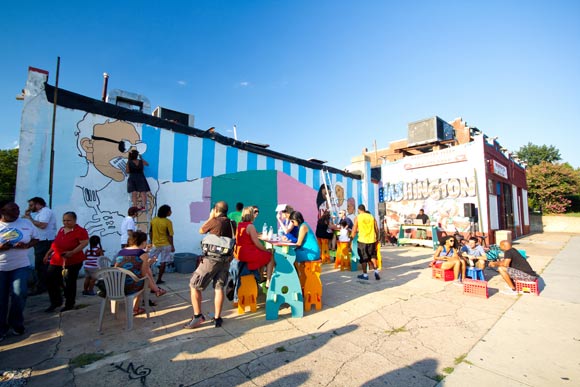
        There is a great diversity in the types of projects that have been funded to date.  Low income or supported housing or live/work sites for artists, mural projects that involve youth in a training component, development of a community arts center, mobile apps that link local artists to potential customers, and a series of art-centric events in an abandoned site exemplify the range of possibilities. This suggests that funding can be available for imaginative larger scale projects where a strong sense of place is integrated with arts and culture to inform project development and final products in a way that brings vitality to a languishing area or community.


        One of the benefits of creative placemaking is that it supports cross- sector partnerships.  Public, non-profit, and private ventures are called upon to work together.  It also invites cross-discipline work, as transportation or housing agency entities may become involved with community or arts and cultural individuals and institutions.  It is seen by many as a way to better leverage an investment because of the many players involved. Some examples follow.


  • Local Initiatives Support Corporation’s (LISC) Institute for Comprehensive Community Development is one of several organizations that have conducted several major creative placemaking projects throughout the US.  One of these was Resilient Communities, Resilient Families, launched in 2011 in Boston.  To engage residents, community organizations, and other stakeholders in the planning process they asked, “What’s next for the neighborhood?”  Artists emerged as key players.  They both articulated the importance of culture in community revitalization and brought creativity to the planning process.  They helped bring to life who lived in the community, what mattered most in terms of quality of life, and why the community was loved through means such as storytelling or creative depictions that went beyond traditional data gathered.  Working to facilitate the success of artists as entrepreneurs, services devised included business plan training, increased access to capital, and expanded venues for arts performance and display.  

        A project highlight was Bartlett Events, a summer-long series of events held at a vacant bus yard slated for redevelopment.  Murals adorned the site as residents came together in new ways.  Another innovation was the development of a social enterprise initiative called New Art Love that created a mobile art application to link local artists to potential buyers for their work.  Descriptions of other projects can be found in their Thinking Out Loud blog about creative placemaking (http://www.instituteccd.org/resources/5010).

  • In Lawrence, Kansas, the Lawrence Arts Center received $500,000 last year from Artplace to implement the “Free State Boulevard: From the Studio to the Streets” project, designed to revitalize and re-engage a six-block stretch that links downtown Lawrence with a warehouse arts area.  Multi-modal paths, upgraded amenities, and new models of urban infrastructure are planned to help integrate and cross-pollinate the two communities.  
  • Fargo, North Dakota received $450,000 from Artplace last year to further develop and implement plans for a World Gardens Commons that would transform an 18-acre storm water detention basin that has historically isolated the Native American and immigrant populations living next to it.  An environmental artist is leading teams of artists in partnership with social service organizations to involve residents in programming and activation.  This builds on the $260,000 awarded in 2013 to the Plains Art Museum for plans for Defiant Gardens in the Fargo-Moorhead communities.
  • The Rebuild Foundation was awarded $125,000 in 2011 by Artplace to convert an abandoned building in the Dorchester neighborhood of Chicago’s South Side into the Black Cinema House Live/Work Space where films, videos, and media works arising from the community will be made, shared, and discussed.  The scope of this project was expanded and additional funding was secured.  The Washington Park Arts Incubator is a joint project of The University of Chicago Arts and Public Life Initiative, the Office of Civic Engagement, and the Center for the Study of Race, Politics and Culture, which built on the initial impetus of the Rebuild Foundation.  It received $400,000 in 2012 to continue work on this vision.  The three artists-in-residence announced for 2013-2014 were a musician and composer, a poet and visual artist, and an artist, designer, and educator.
        As can be gleaned from the above, a major funder of creative placemaking projects is Artplace (http://www.artplaceamerica.org).  It is a consortium of twelve foundations and two anonymous donors, with six major financial institutions as  partners, and several federal agencies providing  advice and counsel as well.  Artplace has invested a total of $56.8 million in 189 projects in 122 communities across 42 states and the District of Columbia since 2012 in amounts ranging from $50,000-$500,000.

        Many of the foundations that are part of the Artplace consortium also fund projects on their own. One of these is The Kresge Foundation (http://kresge.org).  It also partners with other foundation members of the Artplace consortium such as the Surdna Foundation.  The two recently announced a plan to award $1.3 million to seven community development financial institutions in a two-year effort to integrate arts, culture, and creativity into community revitalization efforts.
     
        The document that set the theoretical foundation for the burgeoning field is Creative Placemaking, a 2010 white paper for The Mayors’ Institute on City Design, itself a leadership initiative of the National Endowment for the Arts in partnership with the United States Conference of Mayors and the American Architectural Foundation.  In it, the following definition of creative placemaking was offered:

  • In creative placemaking, partners from public, private, non-profit, and community sectors strategically shape the physical and social character of a neighborhood, town, city, or region around arts and cultural activities. Creative placemaking animates public and private spaces, rejuvenates structures and streetscapes, improves local business viability and public safety, and brings diverse people together to celebrate, inspire, and be inspired.

        Such a broad definition can be good news for folks involved in community psychology and community work, because it means there is room for creatively developing projects that can get some of the generous funding that is starting to be earmarked for creative placemaking.

        One of authors of the 2010 white paper was Ann Markusen, based at the Humphrey School of Public Affairs at the University of Minnesota, where she is Director of the Arts Economy Initiative and the Project on Regional and Industrial Economics.  Her co-author was Anne Gadwa Nicodemus, a choreographer and arts administrator before becoming involved with urban planning.  She is the principal at Metris Arts Consulting and is considered one of the leading experts in the field.  Her website (http://metrisarts.com/creative-placemaking/) has links to most of her pioneering work, including the 2010 report.   (See also a special 2014 issue on creative placemaking sponsored by the Federal Reserve Bank of Francisco, at http://www.frbsf.org/community-development/files/cdir-10-02-creative-placemaking.pdf.)

        Nicodemus has noted some challenges within the new field.  Its metrics are still being developed: How are things like return on investments measured and evaluated and by whom?  Key values like agency, equity, and vibrancy can be elusive. One major criticism is that revitalizing blighted or neglected neighborhoods by making them attractive to arts and culture-minded entrepreneurs and their consumers might displace place the current residents.  Is Creative Placemaking another form of gentrification?  Many of the actors in this field seem to be conscious of this possibility and are looking for projects that actively involve and support residents, who would have  a central role in project design and development.

        Local art and culture can be an essential element of community work;  and local artists and cultural workers, as well as community psychologists, can be key participants in it.   The arts can open people to new possibilities and help build bridges across differences. Including them intentionally in one’s projects can have many benefits, including access to increased funding sources and inclusion in the discussion of an evolving new field.  Best of all, working this way can be a lot of fun for all involved.


This is one of a series of bulletins highlighting the use of community psychology in practice. Comments, suggestions, and questions are welcome. Please direct them to Bill Berkowitz at Bill_Berkowitz@uml.edu