Showing posts with label community building. Show all posts

Friday, February 27, 2015

An Introduction to Creative Placemaking

THEory into ACTion

A Bulletin of New Developments in Community Psychology Practice
February, 2015

by
Elizabeth R. Stone, Pacifica Graduate Institute

        Creative Placemaking can most succinctly be described as an evolving set of practices that involve community members in revitalizing and developing their communities in a way that includes arts and cultural workers and their products to enhance everyone’s quality of life.  It could be argued that projects similar to creative placemaking have been undertaken for decades; however it is only recently that the term has been developed and has been gaining traction as a focus of community development funding and projects. Such projects offer many opportunities to which community psychologists might contribute.

        There is a great diversity in the types of projects that have been funded to date.  Low income or supported housing or live/work sites for artists, mural projects that involve youth in a training component, development of a community arts center, mobile apps that link local artists to potential customers, and a series of art-centric events in an abandoned site exemplify the range of possibilities. This suggests that funding can be available for imaginative larger scale projects where a strong sense of place is integrated with arts and culture to inform project development and final products in a way that brings vitality to a languishing area or community.
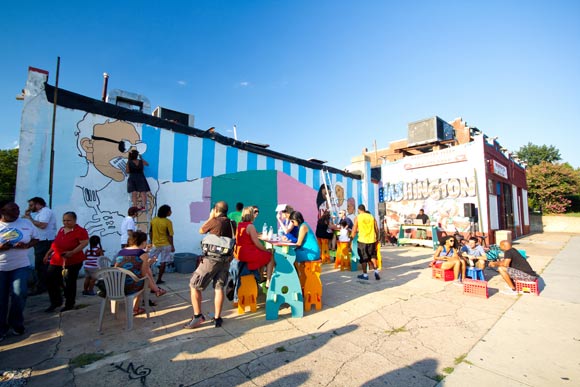


        One of the benefits of creative placemaking is that it supports cross- sector partnerships.  Public, non-profit, and private ventures are called upon to work together.  It also invites cross-discipline work, as transportation or housing agency entities may become involved with community or arts and cultural individuals and institutions.  It is seen by many as a way to better leverage an investment because of the many players involved. Some examples follow.


  • Local Initiatives Support Corporation’s (LISC) Institute for Comprehensive Community Development is one of several organizations that have conducted several major creative placemaking projects throughout the US.  One of these was Resilient Communities, Resilient Families, launched in 2011 in Boston.  To engage residents, community organizations, and other stakeholders in the planning process they asked, “What’s next for the neighborhood?”  Artists emerged as key players.  They both articulated the importance of culture in community revitalization and brought creativity to the planning process.  They helped bring to life who lived in the community, what mattered most in terms of quality of life, and why the community was loved through means such as storytelling or creative depictions that went beyond traditional data gathered.  Working to facilitate the success of artists as entrepreneurs, services devised included business plan training, increased access to capital, and expanded venues for arts performance and display.  

        A project highlight was Bartlett Events, a summer-long series of events held at a vacant bus yard slated for redevelopment.  Murals adorned the site as residents came together in new ways.  Another innovation was the development of a social enterprise initiative called New Art Love that created a mobile art application to link local artists to potential buyers for their work.  Descriptions of other projects can be found in their Thinking Out Loud blog about creative placemaking (http://www.instituteccd.org/resources/5010).

  • In Lawrence, Kansas, the Lawrence Arts Center received $500,000 last year from Artplace to implement the “Free State Boulevard: From the Studio to the Streets” project, designed to revitalize and re-engage a six-block stretch that links downtown Lawrence with a warehouse arts area.  Multi-modal paths, upgraded amenities, and new models of urban infrastructure are planned to help integrate and cross-pollinate the two communities.  
  • Fargo, North Dakota received $450,000 from Artplace last year to further develop and implement plans for a World Gardens Commons that would transform an 18-acre storm water detention basin that has historically isolated the Native American and immigrant populations living next to it.  An environmental artist is leading teams of artists in partnership with social service organizations to involve residents in programming and activation.  This builds on the $260,000 awarded in 2013 to the Plains Art Museum for plans for Defiant Gardens in the Fargo-Moorhead communities.
  • The Rebuild Foundation was awarded $125,000 in 2011 by Artplace to convert an abandoned building in the Dorchester neighborhood of Chicago’s South Side into the Black Cinema House Live/Work Space where films, videos, and media works arising from the community will be made, shared, and discussed.  The scope of this project was expanded and additional funding was secured.  The Washington Park Arts Incubator is a joint project of The University of Chicago Arts and Public Life Initiative, the Office of Civic Engagement, and the Center for the Study of Race, Politics and Culture, which built on the initial impetus of the Rebuild Foundation.  It received $400,000 in 2012 to continue work on this vision.  The three artists-in-residence announced for 2013-2014 were a musician and composer, a poet and visual artist, and an artist, designer, and educator.
        As can be gleaned from the above, a major funder of creative placemaking projects is Artplace (http://www.artplaceamerica.org).  It is a consortium of twelve foundations and two anonymous donors, with six major financial institutions as  partners, and several federal agencies providing  advice and counsel as well.  Artplace has invested a total of $56.8 million in 189 projects in 122 communities across 42 states and the District of Columbia since 2012 in amounts ranging from $50,000-$500,000.

        Many of the foundations that are part of the Artplace consortium also fund projects on their own. One of these is The Kresge Foundation (http://kresge.org).  It also partners with other foundation members of the Artplace consortium such as the Surdna Foundation.  The two recently announced a plan to award $1.3 million to seven community development financial institutions in a two-year effort to integrate arts, culture, and creativity into community revitalization efforts.
     
        The document that set the theoretical foundation for the burgeoning field is Creative Placemaking, a 2010 white paper for The Mayors’ Institute on City Design, itself a leadership initiative of the National Endowment for the Arts in partnership with the United States Conference of Mayors and the American Architectural Foundation.  In it, the following definition of creative placemaking was offered:

  • In creative placemaking, partners from public, private, non-profit, and community sectors strategically shape the physical and social character of a neighborhood, town, city, or region around arts and cultural activities. Creative placemaking animates public and private spaces, rejuvenates structures and streetscapes, improves local business viability and public safety, and brings diverse people together to celebrate, inspire, and be inspired.

        Such a broad definition can be good news for folks involved in community psychology and community work, because it means there is room for creatively developing projects that can get some of the generous funding that is starting to be earmarked for creative placemaking.

        One of authors of the 2010 white paper was Ann Markusen, based at the Humphrey School of Public Affairs at the University of Minnesota, where she is Director of the Arts Economy Initiative and the Project on Regional and Industrial Economics.  Her co-author was Anne Gadwa Nicodemus, a choreographer and arts administrator before becoming involved with urban planning.  She is the principal at Metris Arts Consulting and is considered one of the leading experts in the field.  Her website (http://metrisarts.com/creative-placemaking/) has links to most of her pioneering work, including the 2010 report.   (See also a special 2014 issue on creative placemaking sponsored by the Federal Reserve Bank of Francisco, at http://www.frbsf.org/community-development/files/cdir-10-02-creative-placemaking.pdf.)

        Nicodemus has noted some challenges within the new field.  Its metrics are still being developed: How are things like return on investments measured and evaluated and by whom?  Key values like agency, equity, and vibrancy can be elusive. One major criticism is that revitalizing blighted or neglected neighborhoods by making them attractive to arts and culture-minded entrepreneurs and their consumers might displace place the current residents.  Is Creative Placemaking another form of gentrification?  Many of the actors in this field seem to be conscious of this possibility and are looking for projects that actively involve and support residents, who would have  a central role in project design and development.

        Local art and culture can be an essential element of community work;  and local artists and cultural workers, as well as community psychologists, can be key participants in it.   The arts can open people to new possibilities and help build bridges across differences. Including them intentionally in one’s projects can have many benefits, including access to increased funding sources and inclusion in the discussion of an evolving new field.  Best of all, working this way can be a lot of fun for all involved.


This is one of a series of bulletins highlighting the use of community psychology in practice. Comments, suggestions, and questions are welcome. Please direct them to Bill Berkowitz at Bill_Berkowitz@uml.edu 


Monday, January 12, 2015

The Emerging Non Profit World in Saudi Arabia: A Promising Glimpse

By Tom Wolff


        The email arrived out of the blue in June of this year. The email was titled, “Invitation to speak at top Saudi NPO Conference!” They were inviting me to give a keynote address in early November at the annual non-profit conference at King Fahd University of Petroleum and Minerals in Khobar in the Kingdom of Saudi Arabia. I was baffled – how did they find me? Why did they want me? What were they asking of me?
     
        The last question was made clear in their email: “Knowing you are an expert, academic and consultant in the field of community development, we would like to invite you to speak at our conference and give a keynote presentation about community development and the role of the non-profit sector in light of the roles of the other two sectors (public, business).”

        So, over the next few weeks and months we talked, emailed and negotiated the topic and content of my talk. Ultimately it was titled: Enhancing Collaboration Across Government, Business and Non Profits: Building Healthy Communities in Saudi Arabia.  Throughout that time I wondered what they really wanted from me, what was awaiting me, and what was happening in Saudi Arabia. I let them know that all my community development work and healthy communities work is based on core principles of democracy and was that going to be okay to discuss in the Kingdom of Saudi Arabia (KSA)? They reassured me that it would be fine. So, I proceeded with their support to acquire a visa and booking flights etc.

        I read a few books on visiting Saudi Arabia and started to learn about the country as best I could from here in the US. I learned about the ‘religious police’ who enforce the wearing on burkas for women. I watched a wonderful Saudi movie, Wajdja, (from a female director) about a girl wanting to ride a bike (not acceptable). I checked out the websites on “women driving in Saudi Arabia” – which states that this is the only country in the world where women can’t drive. I learned that a large percent of the Saudi work force (especially lower level jobs) were performed by foreigners (ie 1.5 million from the Philippines). I read on the visa application that violations of Saudi drug laws were punishable by death. I was fascinated and remained baffled.

        I was told that there are 1400 non-profits in Saudi Arabia, 700 of them being Islamic teaching organizations. That leaves 700 doing the work that non-religious non-profits do here in the US. That’s not many non-profits, I imagine we have 700 non-profits just here in western Massachusetts.

        They later informed me that on top of the keynote they also wanted me to offer a 6 hour workshop on the actual ‘how to’s’ of community development and to consult on some of their projects while I was there --- it was going to be a busy visit.

        Just before leaving,  I learned of the amazing roster of presenters that they had lined up for this two day event:  Bunker Roy and Meagan Carnahan of the Barefoot College in India; Iqbal Quadir from MIT focused on inclusive ventures in low income countries ie. Grameenphone in Bangaladesh; Aaron Hurst on the Purpose Economy and  Pro Bono as a Powerful Solution; Rodrigo Baggio of Brazil Center for Schools on Digital Inclusion in Rio’s favelas; Tony Meloto who  builds sustainable communities in slum areas in the Philippines, Farm Village Universities; Robert Ashcroft from Arizona State University on  Creating and Sustaining Non -profit Workforce; Michael Grogan from Calgary, Canada on Workforce development in non-profit sector;, and Stephen Brien from England on Social Impact Bonds. This was a much more fascinating line up of speakers than I have heard at a US non-profit conference in decades.

        Most of them were much more prominent on the global scene than I was ie. Bunker Roy one of “the 100 most influential people in the world” and Rodrigio “top leader in South American to watch” both by Time Magazine. But as my visit evolved it became clear that my host, Salem Aldini (a professor of mechanical engineering), was planning to  develop a Non Profit Institute at King Fahd University and to launch community development projects across the country starting with a few pilots. This was my area of expertise.

        So I began to understand that I was chosen as someone who could convey specific processes and tools for their hand- picked audience of 150 non- profit and family foundation leaders. I could also expose them to tools in the Community Tool Box (ctb.ku.edu) which is translated into Arabic.


        During my four days I began on day one by working with a small group consultation with the faculty who would be the facilitators in my upcoming six hour workshop, gave the kick off keynote address, followed by an afternoon discussion session.  Then, two days later, a consultation to the teams planning the community development pilot and another team working on youth interventions who were looking for innovative ways of assessing youth needs. Finally I delivered a six hour workshop to a small hand chosen group of 35 non- profit and foundation leaders. It was a workout for them and me.

        The Saudi faculty, foundation and non- profit leaders whom I met with in the small group consultations were very serious about trying to bring community development innovations to the Saudi non- profit and foundation world. They asked lots of questions, took lots of notes. Clearly, they were most curious about this work. This is startling in light of the repression and limited practice of democracy in Saudi Arabia. We often got to the point in a discussion, especially when talking about evaluation and documentation, where they said that although the government collects data it is generally unavailable to those in the university, foundation and the non-profit world.

        In one small group I did learn of people working at the community level bringing the three sectors (business, government, non- profit) together to address crises over the last few years such as: the flooding in Jeddah, the influx of Kuwaiti refugees after the Gulf War, and helping female teachers get transportation to work.

        The second class citizenship of women was always present in our discussion. The keynote audience was all male in the auditorium, while the talk and slides were also shown in a separate conference room to the women. At the buffet breakfast one morning a woman in full burka addresses me; she was a participant in the other room – liked my talk but complained about Bunker’s Barefoot College because it took the Grandmas away from villages to become solar engineers. Why not take the men? She is Secretary General of the International Islamic Women’s Association. I asked if it was alright for me to sit with her for breakfast (I was fascinated). Although, she said ‘yes’, when I sat down she spent all her time of the cell phone – so I assumed it was not really acceptable and I moved.

        A few people attending the conference explained to me that Mohammed both worked and prayed side by side with his wife – so that the precedent for the separation of the women was not really clear.

        Of course, in most cultures, to my knowledge women do the core community building work, often below the radar. That has been true in almost all my community development and coalition building work in the US. But in KSA, it is tricky to build coalitions because men and women have to be separate – we were deep into a conversation about a planned model community development project in a limited geographic area (a city neighborhood) when I asked whether we would be able to mobilize the men and the women together – I was told “no”, that it would be two separate but coordinated efforts – mind boggling to an American community builder.

        But interestingly enough, at 9 PM in my workshop all of a sudden a number of the men left – I was later told that they had promised their wives that they would be home by 9 PM!


        Religious questions often surfaced during my visit. In almost all the question and answer sessions there would be statements about what the Koran said. Often these questions were not really questions but some statement of Islamic teachings that might or might not relate directly to what had just been said. Many of the Saudis were eager for us to leave with a better understanding of Islam. To that end, we were presented with copies of the Koran and a six set DVD set on understanding Islam.

        My workshop was entitled “Enhancing Collaboration with Government Business and Non Profits – A workshop on Tools and Processes for Success.”  It included an overview of collaboration, and the five key principles of collaborative solutions from my book (The Power of Collaborative Solutions). I helped them take a view of non-profit functions beyond individual, remedial work done by professionals and to expand to working with families, tribes, the whole society and going beyond remediation to include prevention, development and empowerment as legitimate non-profit functions. This seemed to be an important expansion of scope for them. We covered planning tools such as: coalition start up and planning, SWOT Analysis, visioning, force field analysis, developing a road map, barriers, tools for engaging the community and finally collaborative leadership. The Community Tool Box was demonstrated. The participants were eager to engage with all the material but it was hard to tell exactly how much they would actually take back with them and use. Doing an English/Arabic bilingual workshop for 35 participants over six hours with two breaks for prayer was a new experience for me. Having all the worksheets translated into Arabic was wonderful but it made it impossible for me to indicate which the appropriate page was. They all seemed to humor me as we proceeded, and I will be anxious to see the evaluations. The informal feedback after the workshop was very positive.

Some startling other learnings: 

  • English is the official language at King Fahd University (and also in the Saudi business world), KSA was described jokingly as the 51st US state.
  • The average size of a Saudi Family Foundations was said to be $10 Billion!
  • The warmth and hospitality of the Saudis was remarkable. People were always offering to help and sincerely interested in our well- being during the stay. One afternoon my very accommodating host, Ahmad, was going to take me to a store where we could buy dates to take back to my family. We went to the nearby mall but it was closed for prayer, so as we were leaving we saw two men having a cup of coffee (or Arabic tea). Ahmad asked them for a recommendation of a store and directions and they had a lengthy chat. We then went to find Ahmad’s car, but just like in the US who can find their car in a Mall’s parking lots? About five minutes later one of the men we had just talked to came running up. He had thought of a better date store for us to go to. Amazing hospitality! 


So what did I bring home?


        I loved the adventure and foreignness of the whole experience in a totally different culture.

        I was excited by the opportunities that Salem Aldini has opened up for a developing non-profit world in KSA.

        I am eager to help in the next phases of their progress. Many participants indicated that they were eager to have me come back – but in all honesty I am not sure that that wasn’t just Arabian hospitality and warmth. On the other hand, Salem informed me that he arranged for my visa to be good for five years (the visa is in Arabic so I have no idea what it says) – so maybe I will return. I would enjoy that.

        Also, I was able to reflect on how my enthusiasm for the future of non-profits in KSA did not match my experience of the non- profit world in the US in 2014. Here, I see the non- profit world becoming increasing conservative, become averse to risk, and to sticking their neck out and naming the issues that stare us in the face (racism, economic inequality, etc.). Maybe we in the US can re-capture that sense of adventure that comes from an emerging non-profit sector – but I am not sure what will make that happen.


Tom Wolff

Friday, March 7, 2014

Can Random Acts of Kindness Strengthen Communities?

This past weekend was the third Annual Melee of Kindness (AMOK). Playfully named after a word synonymous with craziness ( and technically defined as a psychological disorder characterized by random acts of mass violence), AMOK is actually devoted to random acts of kindness. Promoted by the nonprofit Random Acts, AMOK encourages people throughout the world to perform acts of kindness in their local community.

It's a cute idea, but can it be more? As community psychologists, we typically look for ways to strengthen communities that are locally grounded, systematic, and sustainable. Some decry one-day volunteer events (such as those promoted by businesses to promote "team-building"), for their ability to engender good feelings in one-shot volunteers without actually creating any kind of lasting effects.

I understand this critique, though I have seen examples of short-term events that have long-lasting impacts. For example, hackathons devoted to social betterment, such as the Hackathon for Social Good, bring together programmers and designers for a concentrated period of time to develop innovative technological solutions to challenges faced by nonprofits. Although sustained work is needed to maximize the usefulness of apps and other products developed during these events, mass participation and the short-term intense nature of hackathons can lead to innovations that wouldn't otherwise occur.

As far as Random Acts is concerned, it's worth mentioning that AMOK is just one event in an ongoing effort to promote random acts of kindness. However, this still begs the question, do random acts of kindness actually do any good?

Without minimizing the importance of sustained well-funded multilevel approaches to preventing social problems and strengthening communities, I'd like to make a case for the virtues of promoting kindness (and randomness), and particularly for the approach adopted by Random Acts.

(1) Random acts of kindness may increase recipient's sense of informal social support and social connectedness. The importance of social support cannot be underestimated. The One Strong Ohana child maltreatment prevention campaign, which I've mentioned previously, promotes seemingly "random acts" of kindness towards families, such as offering to babysit or pick up groceries for a neighbor. These small acts increase a sense of social support, which is a proven protective factor against child abuse and neglect. Informal social ties are essential to individual and community well-being, and even small acts can go a long way toward increasing the sense that people can rely on their neighbors. For instance, Carlos Luis has written about the "suspended coffee" concept, whereby people pay in advance for a cup of coffee or a meal that could be claimed later by anyone who needs it. This concept has taken off around the world, and may be a way to promote solidarity and social cohesion.

(2) Random Acts (the organization) repeatedly emphasizes taking action in your community and "transforming your neighborhood." Unlike other one-day events (such as the "team-building" corporate volunteer events alluded to previously), this approach encourages people to engage deeply with their own communities, to seek out problems that need to be fixed, and to take action that may lead to long-lasting community change.

(3) Engaging in random acts of kindness in one's own community may promote a sense of influence, one of the core elements of psychological sense of community. This may be enhanced when several people work together and accomplish something that they may not have otherwise thought possible, promoting a sense of empowerment and collective efficacy which could potentially lead to future collective action. It may also raise awareness about community problems that are otherwise ignored, which, when combined with an increased sense of collective efficacy could potentially lead to larger scale change. For instance, a group of people who spend a day reaching out to homeless members of their community may become more deeply aware of the problem of homelessness, and continue to work together or become involved in existing efforts to effect policy changes that could address this problem.

(4) The organization provides a global platform and makes extensive use of social media to document and share local experiences. This can promote intercultural dialogue and creates a shared history among participants, locally and globally, devoted to community betterment.


(5) It's refreshing to engage with a nonprofit whose primary request is not to donate or sign a petition, but to simply do something positive. Random Acts does ask for donations, which it uses to fund project proposals put out by participants. However, it is currently run entirely by volunteers, affording it a certain amount of freedom from the dilemma faced by nonprofits that feel a tension between remaining true to their mission and keeping their staff employed. Though Random Acts is only a few years old, and will likely find itself struggling with that tension if it continues to grow in the next few years, the fact that people can "participate" without ever actually even having any contact with the organization provides a unique experience for would-be volunteers.

Also, they really are cute. Seriously, they're adorable. Co-founded by actor and social media overlord Misha Collins, whose childhood experiences with homelessness and the unexpected generosity of strangers inspired this organization's inception, Random Acts is full of dedicated people who genuinely want to make the world better in every random way they can. This includes unpaid staff who work tirelessly to maintain the site and organize events, one of whom wrote about how her experiences have convinced her of the real potential of this approach, "It started with what sounds like an almost too simplistic mission: we can change the world through small acts of kindness, But I actually believe that to be true." It also includes groups working together to clean neglected community spaces or raise funds for local nonprofits, and individuals snowblowing their neighbor's yards or even taping quarters to vending machines.

In addition to AMOK and other projects, Random Acts is associated with another annual event with the unruly acronym GISHWES, which stands for the "Greatest International Scavenger Hunt the World Has Ever Seen." Surprisingly, it actually lives up to the hubris of its name, having attained multiple Guinness World Records for being the world's largest scavenger hunt. GISHWHES includes a list of activities that range from the randomly kind (e.g. "grab a friend and go donate blood or platelets", "perform a stealth act of kindness for someone at work"), to the just plain random (e.g. "make a wig from your own hair", "create a portrait made entirely of Skittles", "dress up like a stormtrooper and fold laundry").

I'll admit that the merits of making Skittles portraits may seem small when considering the overwhelming and pervasive problems faced by people across the globe. However, I personally believe that kindness, silliness, and art are undervalued as potentially transformative forces in a world dominated by competition for money and power. Then again, that's just how I roll...

-----
Gina Cardazone - University of Hawai`i, Mānoa

Tuesday, July 26, 2011

Community Psychologist Practitioner Spotlight: Pamela Imm


“I frequently tell people that I have the best job in the world.  It is fun and provides interesting work that is rewarding on a lot of levels.  I enjoy telling people what I do for work although I find that I never answer that question in the same way.”

Name: Pamela Imm, Ph.D.
Title: Community Psychologist
Employer: Self Employed; has office at LRADAC
Affiliations:  American Evaluation Association, Society for Community Research and Action

Using Community Psychology to Help Communities Find Effective Solutions
---
Dr. Pamela Imm is a community psychologist practitioner who uses her skills in evaluation to help communities find solutions to large scale community issues.
She is affiliated with the Lexington/Richland Alcohol and Drug Abuse Council (LRADAC), a non-profit agency that provides prevention, intervention and treatment programs to South Carolina citizens. Through this agency, she works as an evaluator with four different community coalitions to help prevent risky behaviors among youth. Her role as an evaluator involves providing strategic direction and assessing the effectiveness of community-based programs. Dr. Imm is also self-employed and works with other coalitions around the country that address violence prevention, underage drinking and youth development and leadership programs. She is a big advocate of doing what works. She serves as a consultant and presents specific evidence-based strategies and programs for community groups and coalitions to consider.

Dr. Imm also conducts research and publishes with her colleagues. These publications include Using the Getting to Outcomes Approach to Help Communities Prevent Underage Drinking (2007) and The Premises is the Premise: Understanding Off-and-On Premises Alcohol Sales Outlets to Improve Environmental Alcohol Prevention Strategies (2011). She and her colleagues received the 2008 American Evaluation Association Award for Outstanding Publication for Getting to Outcomes: Methods and Tools for Self-Assessment and Accountability. A number of health agencies around the nation have adopted this model.

She has a strong interest in integrating research into practice. Her work is disseminated into the community and is available for organizations to use. She is also involved in providing training and technical assistance and continues to study best practices and strategies in providing technical assistance in community settings.

Dr. Imm possesses the necessary skills to work in a variety of settings as an evaluator, a consultant, a researcher and a grant writer. An understanding of how to apply key concepts in psychology (especially community psychology), is an important skill that Dr. Imm has gained through her graduate training and years of experience. She earned her Ph.D. in clinical-community psychology at the University of South Carolina. During graduate school, she gained community psychology practice experience by working on neighborhood projects with her mentors and research lab. The interdisciplinary nature of her graduate training provided mentors across disciplines such as public health. She also gained skills in developing and implementing applied practices that were contextually appropriate and empirically grounded.

As a community psychologist practitioner, Dr. Imm serves in various professional capacities that help to ensure strong, healthy communities. Her commitment to making a positive impact on both a local and national level is demonstrated by the practice of informing the community about what strategies work and how to implement them.


-------------
This profile was written by Kyrah Brown, from Wichita State University.  It is part of a series of community psychology practitioner profiles.  If you have a suggestion for future profiles, please email scraprofiles@gmail.com

Wednesday, July 13, 2011

Delivery Boy

Three times a year, I’m a delivery boy. My job is to deliver the Neighborhood Newsletter to about 100 homes on the streets of my suburban neighborhood near Boston. You might see me going door-to-door and placing newsletters under doormats, wedging them in door handles, or covering them with a small stone so they don’t blow away.

But why is this worth writing about for community psychologists? Because the Neighborhood Newsletter is unusual, in several ways. First is its pure longevity; it’s been published and hand-delivered free of charge for almost 20 years now, usually in eight-page issues, attractively designed and professionally printed. A volunteer network of about 20 neighbors distributes it to every household in our neighborhood of about 2000 people. To do this costs about $2000 a year. And what’s just as unusual is how that money appears – there are no ads, no subscriptions, no memberships, no dues; just voluntary contributions. Neighbors simply send checks, often without prompting.

A printed neighborhood newsletter also seems unusual in this digital day and age, when everyone is online and when people seemingly have more important things to care about than neighborhood life. But most neighbors seem to like and value the Newsletter. Many say so personally; some will write for it; a few even come to planning meetings. The Newsletter has almost died several times; it’s always been a fragile flower; but at this writing it’s still breathing.

But perhaps what’s most unusual is how the Newsletter relates to the nature of the neighborhood. That nature is complex, maybe paradoxical. For example, when doing my route, I don’t run into many people, basically since there aren’t many people to run into. People are inside, or they are away; life on the street is hard to find.

When I do meet someone, though, they are almost always friendly. We’re likely to chat (in academic lingo, we build social capital). I’ve made thousands of deliveries by now, and no one has ever been unpleasant, nor has any one ever acted suspicious of what I was doing, even when lurking around their doorstep and trying to squeeze a newsletter under their front door.

There’s more: most of my neighbors, I know from experience, like our neighborhood. Many have told me it’s close to perfect. On the other hand, most will also tell you that their neighborhood involvement is low to nonexistent. I’ve found as well that they don’t know many of their neighbors, that they don’t hang out with them, and that they’re not particularly motivated to do so. Despite all this, they still seem to value the small strand of connection the Newsletter brings, with stories about interesting neighbors, new arrivals, the housing market, or the occasional neighborhood event.

Draw your own conclusions. Mine are fairly simple: neighbors, and people, need some sense of community. The neighborhood helps provide it. A little goes a long way. Most neighbors don’t expect or seek more, though they’d usually take it when offered to them. But they do need that little bit.

Our economic future (read the headlines) calls for stronger local community life. One of our roles as community psychologists – and as citizens – is to make more offers, to create more opportunities for local connections. In a tiny way, that’s what we deliver with the Neighborhood Newsletter. I hope I’ll be a delivery boy for some while to come.

An online version of the Neighborhood Newsletter is available here.

Guidance on starting a neighborhood newsletter is available here.

---
Post by:
Bill Berkowitz