Showing posts with label program evaluation. Show all posts

Thursday, March 27, 2014

Don't forget to take a look at AEA's Blog this week!

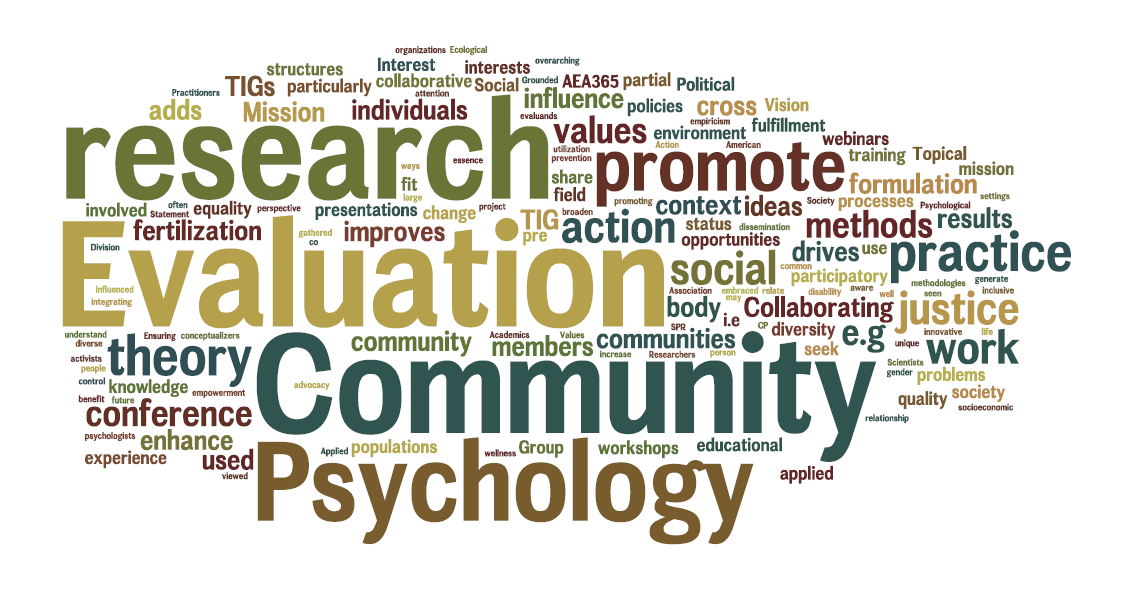
The Community Psychology Topical Interest Group is hosting the American Evaluation Association's Blog this week and they're posting very interesting content in regards to Evaluability Assessments.

Here's a quick view of what has been posted throughout the week:

Make sure to follow up with their blog as they'll continue to upload content through the week.


Friday, March 21, 2014

Community Psychology Topical Interest Group hosts AEA's blog

By Ann Webb Price, Ph.D.

The Community Psychology Topical Interest Group or CP TIG is a group of community psychologists and community practitioners within the American Evaluation Association (AEA). The group was established three years ago to provide a professional home to those who share the values of community psychology within AEA. You can learn more about the TIG at http://comm.eval.org/CommunityPsychology/Home/

One of the many things AEA does is to sponsor a blog called AEA 365. AEA members post a blog each day that highlights specific techniques, resources, and tips for evaluators. The following week (March 23-28), the CP TIG is hosting AEA 365 blog and guest bloggers will be discussing evaluability assessment. The blog series should prove to be illustrative with evaluators such as former AEA president Deb Rog, Jim Altschuld (author of the Needs Assessment kit through Sage), Rob Fischer, Co-Director of the Center on Urban Poverty and Community Development at Case Western Reserve University-CWRU, and Julianne Manchester, Principal Investigator for the National Training and Coordination Collaborative (CWRU) sharing their views on conducting evaluability assessments.

Be sure and check out our postings at http://aea365.org/blog/ and share them with your friends and colleagues. You can learn more about AEA at www.eval.org If you are member of AEA already, please select the Community Psychology TIG on your membership page.

Thanks!


Tuesday, July 26, 2011

Community Psychologist Practitioner Spotlight: Pamela Imm


“I frequently tell people that I have the best job in the world.  It is fun and provides interesting work that is rewarding on a lot of levels.  I enjoy telling people what I do for work although I find that I never answer that question in the same way.”

Name: Pamela Imm, Ph.D.
Title: Community Psychologist
Employer: Self Employed; has office at LRADAC
Affiliations:  American Evaluation Association, Society for Community Research and Action

Using Community Psychology to Help Communities Find Effective Solutions
---
Dr. Pamela Imm is a community psychologist practitioner who uses her skills in evaluation to help communities find solutions to large scale community issues.
She is affiliated with the Lexington/Richland Alcohol and Drug Abuse Council (LRADAC), a non-profit agency that provides prevention, intervention and treatment programs to South Carolina citizens. Through this agency, she works as an evaluator with four different community coalitions to help prevent risky behaviors among youth. Her role as an evaluator involves providing strategic direction and assessing the effectiveness of community-based programs. Dr. Imm is also self-employed and works with other coalitions around the country that address violence prevention, underage drinking and youth development and leadership programs. She is a big advocate of doing what works. She serves as a consultant and presents specific evidence-based strategies and programs for community groups and coalitions to consider.

Dr. Imm also conducts research and publishes with her colleagues. These publications include Using the Getting to Outcomes Approach to Help Communities Prevent Underage Drinking (2007) and The Premises is the Premise: Understanding Off-and-On Premises Alcohol Sales Outlets to Improve Environmental Alcohol Prevention Strategies (2011). She and her colleagues received the 2008 American Evaluation Association Award for Outstanding Publication for Getting to Outcomes: Methods and Tools for Self-Assessment and Accountability. A number of health agencies around the nation have adopted this model.

She has a strong interest in integrating research into practice. Her work is disseminated into the community and is available for organizations to use. She is also involved in providing training and technical assistance and continues to study best practices and strategies in providing technical assistance in community settings.

Dr. Imm possesses the necessary skills to work in a variety of settings as an evaluator, a consultant, a researcher and a grant writer. An understanding of how to apply key concepts in psychology (especially community psychology), is an important skill that Dr. Imm has gained through her graduate training and years of experience. She earned her Ph.D. in clinical-community psychology at the University of South Carolina. During graduate school, she gained community psychology practice experience by working on neighborhood projects with her mentors and research lab. The interdisciplinary nature of her graduate training provided mentors across disciplines such as public health. She also gained skills in developing and implementing applied practices that were contextually appropriate and empirically grounded.

As a community psychologist practitioner, Dr. Imm serves in various professional capacities that help to ensure strong, healthy communities. Her commitment to making a positive impact on both a local and national level is demonstrated by the practice of informing the community about what strategies work and how to implement them.


-------------
This profile was written by Kyrah Brown, from Wichita State University.  It is part of a series of community psychology practitioner profiles.  If you have a suggestion for future profiles, please email scraprofiles@gmail.com

Sunday, May 1, 2011

Community Practitioner Spotlight: Eric P. Green

Name: Eric P. Green, Ph.D.
Titles:
Research Associate and Adjunct Assistant Professor
Employers:
The Population Council and New York University
Affiliations:
Innovations for Poverty Action, Research Network
Website:
www.ericpgreen.com

Promoting Global Health through Practice, Research and Technology

Dr. Eric P Green is a community psychology practitioner whose work is positively impacting the lives of people across the world. His training in community psychology has played a vital role in his current work. His work is illustrative of community action guided by community psychology principles, including the respect for human diversity, social justice, and individual and community wellness.

As an Associate in the Population Council’s Poverty, Gender and Youth Program, Dr. Green is leading a project called Demographic Data for Development. His work involves data sharing and use in three African countries. He and his colleagues are collaborating with in-country partners to help journalists to access and use data in their reporting on health and developmental issues. For example, this project focused on policymakers and their reports of the current data being used and the data they want but do not receive to develop and improve certain policies.

The Population Council is an international, nonprofit, nongovernment organization that aims to improve the well-being and the reproductive health of people around the world. The Council also seeks to help achieve “a humane, equitable and sustainable balance between people and resources.”  In addressing their mission, the Population Council conducts research on HIV/AIDS, reproductive health, and poverty, gender and youth to improve policies, programs and products in over forty countries.

Dr. Green is also an Adjunct Assistant Professor of Global Public Health in the Public Health Master’s Program at New York University. He teaches students about the use of technology in computers and communication in global health, and the perspectives and policy challenges that influence action in global public health.

The nature of Dr. Green’s work at the Population Council requires a number of skills in research, communication, technology, critical thinking and so on. For Dr. Green, graduate training has played a vital role in his current work. He earned his Master’s of Arts in International Studies and his Doctorate in Clinical-Community Psychology from the University of South Carolina.
 
According to Dr. Green, the Clinical-Community Psychology program was a great fit for him. He gained a solid foundation in prevention, program evaluation and developed skills using GIS – a tool he continues to use in his job.  He also utilizes mixed-method research strategies and acknowledges the importance of ecologically oriented and culturally-anchored approaches to interventions for communities.  

While in graduate school, Dr. Green worked with a regional food bank through his community practicum. Through this experience he was able to understand how non-profits work and how research and programming coexist. He also spent eight months in northern Uganda conducting fieldwork for his dissertation. These experiences were certainly helpful in preparing him for his current work, which involves collaborating with both regional and international groups. 

The confluence of his training in community psychology, application of innovative technology and commitment to improving global health has helped make a positive impact in communities around the world.


------ 
This profile was written by Kyrah Brown, from Wichita State University.  It is part of a series of community psychology practitioner profiles.  If you have a suggestion for future profiles, please email ComPsychPractice@gmail.com