Thursday, February 28, 2013

What Can We Really Do About Gun Violence?

We have an opportunity here for genuine dialogue. Not just dialogue, but collective problem solving. We can never eliminate violence, but there are some answers to the questions that have been looming in so many of our minds since December 14th.

Question #1: How can anyone do something so horrible? This is a question whose answer will never fully satisfy us, no matter how deeply we pry into the specific details of this shooter's personal history. However, there have unfortunately been enough mass shootings that we can begin to see common threads in their histories.

From Slate's ongoing Gun-death tally
One of the guiding principles of community psychology is that the individual must be understood in context. Variations on the social ecological model abound, and I'll base my rundown of the factors on  a simplified version.

Individual level
  • Mental illness that is often untreated, undertreated, or misdiagnosed and mistreated. Most commonly, mass shooters have been suspected to have psychotic disorders, personality disorders such as narcissistic or antisocial personality disorder, and/or atypical depression, including suicidality with hostile intent.
  • Access to guns, training in how to use guns, and fascination with guns and violence. 
  • Gender = male.
Interpersonal level
  • Peer rejection. 
  • Family difficulties, sometimes including a history of child abuse and/or neglect. 
  • A precipitating event, usually involving loss, rejection, or humiliation, occurring shortly before the shooting.
 Community/Society levels (these are broadly shared, and subject to debate)
  • Glorification of violence in media and culture, and particularly the idea that gun violence is an effective means to solve problems. 
  • Norms of masculinity that promote aggression, especially the ideas that men are entitled to have power over others, and that aggressive acts can restore masculinity that has been threatened by rejection or humiliation. 
  • Promotion of fame as an ideal, and media coverage that reinforces and rewards violent behavior with fame. 
Looking at these factors, one can construct a loose narrative of a male shooter that has experienced a lifetime of psychological and interpersonal problems; experiences some kind of negative event such as losing a job, fighting with a family member, or being rejected by a potential love interest; is not able to effectively cope with this event; lives in a culture that promotes violence as a means to solving problems, restoring masculinity, and achieving fame; and has access to guns and knowledge of how to use them. It still doesn't exactly explain why on Earth a human being would shoot 20 children and several adults, because nothing ever will. But it takes a bit of the mystery out of how this kind of thing could have occurred.

There may be some shocking revelation that differentiates this most recent mass killer from all the others, but there has already been confirmation that at least some of these factors were in play, and there may be nothing more than that.

Now, to Question #2: What can we do about gun violence? This is a broader question than simply asking what we can do about mass shootings. The vast majority of gun violence does not occur in such dramatic events, and economic inequality plays a much larger role in other types of violence. However, we can start by asking what we can do specifically about mass shootings of this kind. How can we make sure that we are doing everything we can to try to prevent this from happening again?

Some ideas have already been bandied about, explicitly or otherwise, in the aftermath of this and other mass shootings. We can:
  • Arm guards and/or teachers at elementary schools.
  • Give children bulletproof backpacks.
  • Profile people who exhibit some of the characteristics listed above, such as mental illness or problems with peers, or other characteristics such as how they dress, and assume they are potential shooters.
  • Ban violent media of all kinds, or scapegoat particular musicians or movies.
  • Ban guns. Give everyone guns. Keep engaging in unproductive debates about gun control. 

These are stupid ideas.

Pardon my bluntness, but these things will not work. And I can spend the rest of this post dissecting what is wrong with each of these approaches, but I think most of us can agree that these approaches will not lead us anywhere.

So what may actually work? This is where we need to have some genuine dialogue and engage in some real problem solving. The factors that have been associated with mass shootings can point toward some of the ways we can address this, and it's best to address community problems and public health issues in multiple ways at once. So we may increase access to treatment for mental illnesses, implement anti-bullying programs in order to limit rejection of people based on mental illness or other factors, increase awareness of symptoms or warning factors that indicate that a violent event may occur, and collectively address violent media and gun control in ways that may actually be productive and not threaten anyone's 1st or 2nd amendment rights.

I'm particularly fond of strengths-based approaches to violence prevention, and activities that not only decrease the chances of bad outcomes, but actually improve people's lives. For instance, an approach to threat assessment developed by researchers at the University of Virginia dedicated to preventing targeted acts of violence in schools focused on early action in addressing bullying and interpersonal conflicts. Schools that adopted this approach reported more positive perceptions of school climate from students, as well as increased willingness to seek help, decreased bullying, and fewer suspensions. 

As someone who has been personally affected by gun violence and who is professionally dedicated to violence prevention, I'm extremely disappointed to see that attempts to create meaningful change in response to the meaningless violence that has claimed so many lives has so quickly devolved into bitter partisan business as usual. The media is certainly to blame for much of this, as sensationalist headlines about Sandy Hook-deniers and anticipated staring contests between crime victims and Ted Nugent have received far more coverage than any kind of sensible discussion or attempts at compromise. But I also think that many of us have bought into this, and are using this issue as just one more way to villainize our political opponents.

This is not to say we should shy away from difficult and oftentimes controversial conversations. To those who say that laws specifically dealing with guns aren't needed, I will say: Yes, they are. If you think guns don't kill people, then I guess nuclear weapons don't kill people either, right? People do. But we want to minimize the amount of damage homicidal people can do, so we have laws about bombs and grenades and we should have laws about guns as well. Heck, we have laws about cars. Lots of them. And without them we'd all be dying from car accidents a lot more than we are now. So yes, we need laws about guns.

However, to those who think that these kinds of laws by themselves are enough to prevent gun violence, I will say: No, they will not. And I think you know it, too. And now that I've assured everyone that we're all pretty much equally wrong, can we please move on? More than anything, I implore you to keep thinking about this issue - not to let the headlines or pundits dictate what we think, or when it's okay to stop thinking about this because some other event has grabbed our attention. This is just too important.

Resources:

Society for the Psychological Study of Social Issues (http://www.spssi.org) School Shooting Position Statement

Melissa Institute for Violence Prevention and Treatment (http://www.melissainstitute.org) "Violence is Preventable"  and Call to Action on Gun Violence

Society for Community Research and Action (http://www.scra27.org) SCRA's Rapid Response Action and Position Statement on Gun Violence

Want to contact Congress? Find your representative here or here 


References

Borum, R., Cornell, D. G., Modzeleski, W., & Jimerson, S. R. (2010). What can be done about school shootings? A review of the evidence. Educational Researcher, 39(1), 27–37. doi:10.3102/0013189X09357620

Cornell, D., Sheras, P., Gregory, A., & Fan, X. (2009). A retrospective study of school safety  conditions in high schools using the Virginia threat assessment guidelines versus alternative approaches. School Psychology Quarterly, 24(2), 119–129. doi:10.1037/a0016182

Kalish, R., & Kimmel, M. (2010). Suicide by mass murder: Masculinity, aggrieved entitlement, and rampage school shootings. Health Sociology Review, 19(4), 451–464. doi:10.5172/hesr.2010.19.4.451


Newman, K., & Fox, C. (2009). Repeat tragedy rampage shootings in American high school and college settings, 2002-2008. American Behavioral Scientist, 52(9), 1286–1308. doi:10.1177/0002764209332546

Wike, T. L., & Fraser, M. W. (2009). School shootings: Making sense of the senseless. Aggression and Violent Behavior, 14(3), 162–169.


Gina Cardazone
University of Hawai`i, Mānoa

Wednesday, February 20, 2013

“Now I Belong”: A Video Ethnography on Adult Literacy Students


I graduated from DePaul in June 2012 with a B.A. in Community Psychology. Through my Field Work class, I’ve got the opportunity to meet Harold, a 71 year-old student at Literacy Chicago, a non-profit organization committed to improving quality of life by providing adult literacy and ESL instruction services.
In this short film, Harold and two other students told me how a community organization helped them overcome their daily challenges and achieve greater self-sufficiency.


*Now I Belong is an ethnographic short film that describes the challenges and the success stories of adult literacy learners. In the United States alone, over 30 million people are below basic literacy skills. As citizens of this society, students explain the difficulties they have had both at practical and psychosocial level. While they felt ashamed and had difficulties with performing even the basic tasks on their own; participating at a literacy program increased their self-esteem, their likelihood to find full-time employment and their active participation in their communities.

By Aysenur Coban

Wednesday, February 13, 2013

Integrating citizen voices in community and economic revitalization.


Volume 2, Number 2 February, 2013

THEory into ACTion
A Bulletin of New Developments in Community Psychology Practice 

Integrating citizen voices in community and economic revitalization. 
Brittany Cofield-Poole and Dawn X. Henderson 


View details

Community psychology is working to integrate citizen voices in community and economic revitalization. Dr. Craig C. Brookins and two graduate students, Brittany Cofield-Poole and Amanda Matson, in the Psychology in the Public Interest Program at North Carolina State University are currently involved in a collaborative project, Uncovering Southwest Raleigh. The project seeks to engage and raise the voices of citizens from Southwest Raleigh to develop a comprehensive plan that will improve community and economic revitalization. The project emerged from dialogue between the City of Raleigh and faculty in the College of Design, Management, and Humanities and Social Science from North Carolina State University. It has multiple aims and goals that include developing strategies that will allow Southwest Raleigh citizens to “enhance and promote a healthy, creative and economically sustainable future for the district” (Uncovering Southwest Raleigh, 2012).

Brookins, Cofield-Poole and Matson bring their knowledge and training in community psychology to the project and seek to 1) engage individual citizens from Southwest Raleigh; 2) capture their diverse voices; and 3) raise the voices of those least-heard through multiple methods. Brookins has served in the field of Community Psychology for more than twenty-years, including work across the continent of Africa, rites-of-passage programs for African American youth, and evaluation projects for numerous community-based intervention programs. His expertise accompanied by that of Cofield-Poole and Matson’s has lifted the importance of citizen participation, collaboration and focus on community strengths, and empowerment. Last year the team, along with a group of undergraduate students, conducted the first phase of data collection to include:

• Brief Registration Survey: The survey was administered to about 130 citizens to obtain preliminary demographic data.
• Clickers (Audience Response System Technology): Responses were collected and timed from participants who attended the community kick-off celebration. Participants used remote control devices and were able to see the range of responses and engage in dialogue about it immediately. The team used this technique to promote immediate feedback from participants that is not evident in paper-pencil surveys.
• Focus Groups/Mapping: Participants were asked about their perception of Southwest Raleigh boundaries and where their neighborhoods were situated. This method allowed the team to delineate the difference between boundaries developed by the city versus those identified by the citizens. Participants were also asked to identify the three most important factors impacting their daily lives and five things they would showcase about their neighborhood.
• Writing Wall: This technique was adopted from a community arts project started by Candy Chang, an artist that integrates street art in urban planning and activism. Participants were provided with a large empty writing space with the words “What I like most about Southwest Raleigh is...” and instructions to write in their response.

The project also plans to use visual voice, a participatory approach that will include youth and eventually senior citizens. By using this innovative and creative method youth serve as the driving force and researchers as the facilitators of the project. This method emerged from Photovoice and incorporates the use of digital images/video to obtain participant perceptions of community, assets and visions for the future (Wang & Burris, 1997). Integrating such an approach promotes meaningful input by the citizens who influence community structures, practices and sociocultural norms. Furthermore, this counters what Nelson and Prilleltensky (2005) describe as policies and programs that are “conceived in the absence of meaningful input from those most affected by them” (p. 55).

There are some preliminary lessons gathered from the project. For one, projects that are interdisciplinary can create tension associated with different perspectives and values. Brookins and his team appear to engage the most with the community, use more practical skills and work to ensure citizens perceive them as partners. Secondly, the team is brainstorming on ways to engage a more diverse pool of citizens. Unfortunately, the majority of citizens who showed up during the kick-off event were White, middle class, retired and highly educated.

 This project demonstrates how citizens are not used as "subjects of a study" but are actively engaged and working to revitalize their community. Furthermore, the skills community psychologists bring to the fold are essential in assisting citizens to develop a community vision for the future.

References:
Nelson, G., & Prilleltensky, I. (Eds.). (2005). Community psychology: In pursuit of liberation and well-being. New York, NY: Palgrave MacMillan.

Uncovering Southwest Raleigh (2012). Retrieved from http://dev.design.ncsu.edu/swraleigh/

Wang, C., & Burris, M. A. (1997). Photovoice: Concept, methodology, and use for participatory needs assessment. Health Education and Behavior, 24 (3), 369 – 387. doi: 0.1177/109019819702400309

This is part of a series of bulletins highlighting the use of community psychology in practice. Comments, suggestions, and questions are welcome. Please direct them to Bill Berkowitz at Bill_Berkowitz@uml.edu.


Wednesday, February 6, 2013

On the Art of Science


Image by Olya Belyaev-Glantsman~
Dr. Leonard Jason has been working in the field of Community Psychology for over 38 years. He recently wrote a blog titled "The Art of Science" for Oxford University Press, which is one of the most widely read academic blogs in the world with over 7,000 subscribers and an average of over 35,000 visits per month. In this provocative blog, Jason talks about the overlap between the fields of science and art, as both fields rely on imagination, creativity, and intuition. Jason believes that Community Psychologists are both adventurous scientists and artists trying to bring social justice to the world.


For the full version of his blog, please visit http://blog.oup.com/2012/12/psychology-social-change-scientist-artist-community/

Olya Belyaev-Glantsman~
Community Psychology Doctoral student
DePaul University

Wednesday, January 30, 2013

THEory into ACTion January 2013


Volume 2, Number 1                                     January, 2013                                                              


THEory into ACTion
A Bulletin of New Developments in Community Psychology Practice


Prejudice: It’s Bad for Your Health  

We’re familiar by now with many of the negative effects of prejudice: it can
be damaging to the person on the receiving end, both psychologically and physiologically; it can prevent expression of one’s full capacities; it limits contributions to society; and it’s an unfair moral judgment, based on insufficient information.
Image by Olya Belyaev-Glantsman~

What may be less apparent is that prejudicial attitudes may have negative impacts upon the person expressing the prejudice, not just on the receiver.  That’s the basic finding of a recent research study led by Khanh Dinh, a community psychologist and professor of psychology at University of Massachusetts Lowell.

Working together with Ivy Ho and Michelle Haynes, both also professors in the same department, and Michelle Holmberg, a former community psychology graduate student there, Dinh and her colleagues tested 500 undergraduate students on measures of bias toward race, gender, sexual orientation, disability, body size, and immigrant status. The researchers then looked at these measures in relation to indicators of personal well-being, including self-reported levels of depression, social support networks, presence of physical symptoms, general perceived health status, and self-esteem.


The team’s key finding was that prejudice and personal well-being are inversely related.  The main results “[indicate] a significant relationship between prejudicial attitudes and negative well-being, particularly in the areas of depression, social support, and general physical health,” Dinh and her team say. Moreover, prejudice tends to generalize: “Prejudicial attitudes in one area were linked to prejudicial  attitudes in all other ones,” while conversely, “positive functioning in one area is related to positive functioning in the other areas.”

While this study is correlational, with further work needed to verify cause, it has broad implications and raises some intriguing practical questions. Does this mean we can increase the well-being of individuals and communities by lowering prejudice? And if that is true, can we successfully intervene to make that happen?

Dinh thinks so. In an e-mail, she writes: “I do believe that if we (as a society) implement systematically and systemically early prejudice prevention programs (i.e., beginning in grade school), even just targeting one form of prejudice (e.g., racism), that we would significantly reduce all forms of prejudice, which would help increase the overall well-being of individuals and communities.”

And her article concludes by broadening the scope: “A reduction or elimination of prejudice would have rippling effects on community and societal well-being overall, including potentially a reduction in the financial costs of addressing health problems related to prejudice.”  Prejudice, in this view, is bad not only for one’s own health; it’s bad as well for the health and the fiscal integrity of our society.
.          
A full report of this research study, with more detailed findings, is scheduled for publication in the Journal of Cultural Diversity. Quotes come from that report in press, unless otherwise indicated.  This Bulletin also draws in part upon a university news release, at http://www.uml.edu/News/stories/2010-11/prejudice_affects_health.aspx.  For more information about Khanh Dinh’s work, contact her at Khanh_Dinh@uml.edu.

This is one of a series of bulletins highlighting the use of community psychology in practice. Comments, suggestions, and questions are welcome. Please direct them to Bill Berkowitz at Bill_Berkowitz@uml.edu.  

Thursday, January 24, 2013

Housing Stability and Academic Success

I want to tell you about a local project with which I am enormously impressed.  I have played no part in it, but have come to admire the project, the public body that initiated it, and the very impressive initial evaluation findings.  I see organizations like the sponsor of this project as very desirable places where Community Psychologists can make meaningful contributions as employees or consultants.

Let’s start with the organization’s Mission, Vision, and Values statements, adopted in 2008: Tacoma Housing Authority (THA) “provides high quality, stable and sustainable housing and supportive services to people in need.  It does this in ways that help them to become self-sufficient, that strengthen communities and that use its public and private resources efficiently and effectively.”  THA envisions “a future where everyone has an affordable, safe and nurturing home, where neighbourhoods are attractive places to live, work, attend school, shop and play, and where everyone has the support they need to succeed as parents, students, wage earners and neighbours.”  Stated Values include Service, Integrity, Stewardship, Communication, Diversity of Staff, Collegial Support and Respect, and Excellence.  THA wants its services to be temporary, transformational, and to help families prosper.

Please see www.tacomahousing.org for a comprehensive view of all THA activities and services.

In its commitment to help students who live in its public housing succeed, THA initiated a Special Housing Program within the service area of McCarver Elementary School, a school with an extraordinarily high student turnover rate in a neighbourhood generating many social indicators of distress.  Many housing authorities provide student resident with homework help and mentors, but THA realized that neither students nor the school could succeed when burdened by such high turnover rates.  In 2011, the year before this project started, 97 % of McCarver students changed during the school year.  A few years before, turnover rate had reached 179%.  THA administrators recognized that children whose lives are disrupted by changing schools so often have a lot of difficulty learning, and their teachers have great difficulty teaching effectively with so many students coming and going.

THA administrators realized that stabilizing family housing would be a key to both student and family success.  Michael Mirra, Executive Director, sees THA’s role as more than landlords, property managers, and real estate developers.  He comments that THA gives vouchers in order to have families remain in place, rather than to escape to other neighbourhoods and then be replaced by other families facing the same challenges.  He also points out that desirable schools draw families and enhance their neighborhoods.

Beginning in the fall of 2011, THA began providing up to 5 years of rental support to up to 50 previously homeless families with children enrolled in kindergarten, 1st of 2nd grade.  These students constitute about 20% of the school’s student body.  During the first year, parents were required to pay rent of $25 a month.  Each subsequent year, they pay an increasing 20% of the rent per year, until they are able to pay 100% after the fifth year.

In return parents had to agree to five conditions:
1. Keep their child enrolled at McCarver;
2. Be very involved with school activities and their child’s education;
3. Work on their own career and financial growth;
4. Work with THA staff to accomplish these goals; and
5. Share data on their child’s progress in school and the parents’ economic development.

To help parents support their child’s education and also become financially independent, THA:
1. Assigned two full time case workers to provide the families with support and resources;
2. Involved over 30 community partners who provide families with services to combat chemical dependence and family violence; and provide parent skills classes, workforce training, and adult education.
3. Sponsors monthly parenting meetings.
4. Requires parents to participate in PTA and other school events.
5. Makes it possible for the children in the program to attend spring break and summer camps, to extend their learning opportunities.

This project is funded primarily with THA ordinary income.  The Bill & Melinda Gates Foundation is supporting a portion of salary for THA’s Manager of Educational Programs and is funding a comprehensive outside evaluation of results.

Results:

Tacoma School District has embraced this initiative in several ways.  McCarver teachers report that they are able to teach more effectively because they have the same students every day, get to know them and meet their learning needs.  The staff has supported unanimously a School District decision to implement the Primary Years International Baccalaureate, a school-wide program that will enrich education for all McCarver students.  In addition to that financial investment, the School District has invested in additional staff development opportunities.  It is collaborating with THA at other schools having significant enrolment of students from families housed by THA.

GEO Education and Research is conducting the project evaluation.  While cautioning that no firm conclusions may be drawn yet, the trends are moving in desired directions:

“A long term analysis of multiple years will be required to determine if desired outcomes are being achieved and sustained.  Program planners and managers did not expect to see measurable, much less significant, changes in student performance in the first year of implementation.  Given the traumas and challenges experienced by the students and their parents, rapid change seemed unlikely.  Yet, our analysis has shown that in one primary indicator of student success – reading – Program students (especially those in grades K-2) made substantial strides during the first year of the program.  In addition, attendance was positively and significantly correlated with these increases in DIBELS (reading) scores.  There was also a decline in the overall mobility rate a McCarver, from 107% in 2010-2011 to 96.6% in 2011-2012.  Program student mobility was 4.5% while the mobility rate of the rest of the student population was 114%.  Mobility rates are highly variable year to year, but this indicator is moving in the right direction.

For more information about this program, contact Michael Power, PhD.  (in Educational Psychology) Manager of Educational Programs: 253.207.4404  mpower@tacomahousing.org

DISCUSSION

On January 2, 2013, I met with Michael Mirra, Executive Director; Nancy Vignec, Director of Community Services; and Michael Power, Manager of Educational Programs to learn more about the McCarver Elementary Special Housing Program and to ask what of the Community Psychology Competencies might be valued by a public housing authority.  Each was very helpful and I thank them for meeting with me.  Throughout the discussion, they returned again and again to the THA Board’s foundational Vision, Mission, and Values statements.  They clarified how this project springs from an increasingly clear understanding that safe, affordable, and stable housing under-girds family, student, and school system success.  They reported that, in addition to the student outcomes described above, participating parents’ earned income had increased 35% during the current evaluation period and parents are much more engaged in both student success at school and their own improvement plans.

The THA program began when there were no models to follow, and they have had to feel their way along as it developed.  One of their early steps was to hire an Education Manager who had been a key administrator in Tacoma School District; thereby strengthening the linkages between housing authority and school district.  Now, seven other housing authorities across the nation have added Education Managers.  A number of housing authorities from around the nation have visited to learn about the program, as has an Assistant Secretary of HUD.  It is pretty clear that this type of project will spread to other housing authorities.

THA authorities see THA as community developers; in addition to their traditional roles as landlords, property managers, and property developers.  They point out that many people choose where to live based upon the quality of the neighborhood’s schools, when they have choice.  People who have resources will tend to migrate away from neighborhoods with poor schools, leaving behind those who lack resources and thereby contributing to neighborhood decline.  That is why merely providing housing vouchers alone cannot generate neighborhood improvement.  THA hopes that stabilizing McCarver Elementary and introducing a strong curriculum taught by faculty with high expectations will contribute to stabilization of the Hilltop Neighborhood of Tacoma, by enabling families to remain in housing and by drawing new families to a desirable neighborhood.

I asked Michael Power to look over the CP Competencies list and tell me whether these skill sets might be desirable to public housing authorities around the nation.  He answered very positively.  I suggest that Community Psychologists might want to get acquainted with their local housing authorities and with other community development organizations.

Al Ratcliffe, Ph.D
Community Psychologist
Tacoma, Washington, USA

Thursday, December 6, 2012

Community Practice in the Age of the Data Scientist

Data is hot. Seriously. The Harvard Business Review has (perhaps a bit wryly) declared Data Scientist to be the sexiest job of the 21st century. Everyone from the New York Times to the White House blog has chimed in about how Big Data is changing the world.
Nate Silver: Sexiest man alive? 

What is Big Data and why is it such a Big Deal? The answers to those questions are long and varied, but I'll attempt to give the cliffs notes version.

(1) Data is being generated at an exponential rate.
In a remark that's often quoted in pieces on information overload, Google's ex-CEO Eric Schmidt famously alleged that we generate as much information in 2 days than we did from the dawn of humanity until 2003. Much of this data comes from new technologies (e.g. social media, GPS, online video)

(2) Data can be shared, combined, and analyzed at an unprecedented level.
The kind of information that may have once resided in file folders (think Data.gov) or later in Excel spreadsheets can now be shared online and merged with other data sets to form new frankendatasets.

Clearly, there's a lot of potential for social good. Data about health, the environment, and community well-being can be used to make informed decisions about all manner of activities. Recognizing that this is the case, but that many organizations working for social good may not possess the skills necessary to take advantage of this, groups of civic-minded data scientists have formed. This includes Statistics without Borders, which is run by the American Statistical Association, and Data Kind, which organizes events they call Data Dives and is developing a Data Corp for volunteers (and totally deserves its own blog post).
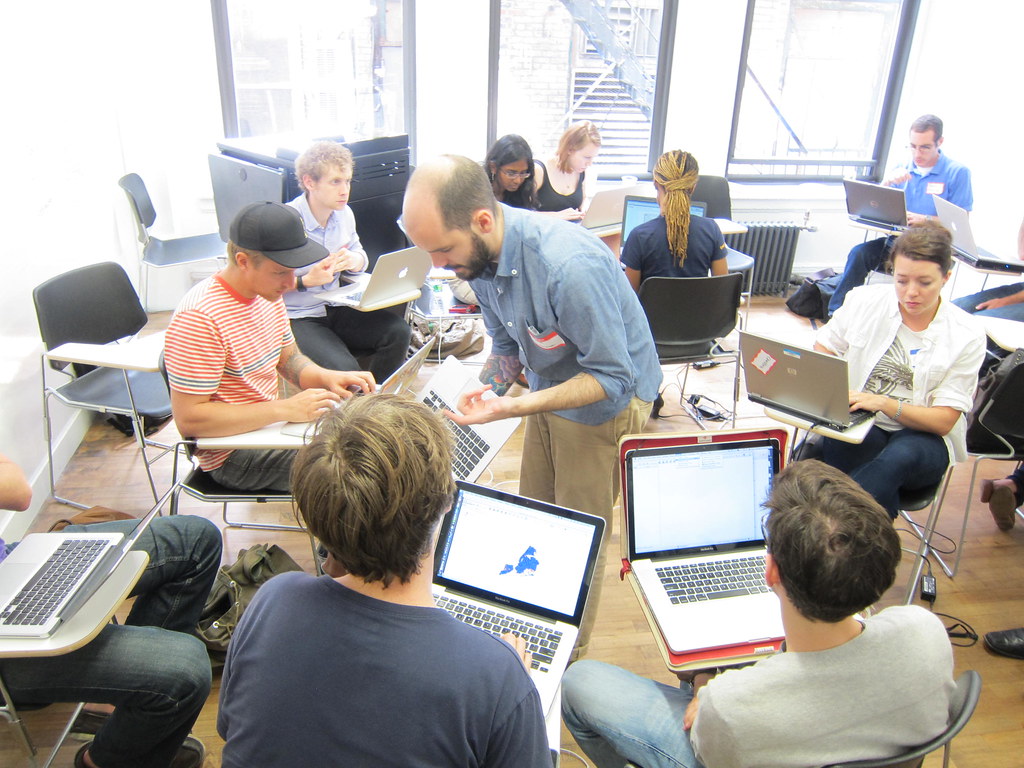
DataKind's awesome volunteers help NYC parks

Of course, there are potential downsides to the hype surrounding Big Data. As noted by Oxford research fellow Mark Graham, the availability of vast quantities of data from certain sources may lead us to focus our research on a skewed and self-selected segment of the population. Furthermore, the analysis of large sets of merged decontextualized data can blind us to the reality of our diverse social world, in which everything exists in its own unique cultural context.

It's here that Community Psychology Practitioners really have a chance to offer something that's needed. Though we don't typically work with petabytes of data, most of us can be considered to be trained data scientists - capable not only of running analyses but of generating useful research questions and designing predictive models that help us make the most out of data. However, our fundamental values ensure that we don't reduce people to statistics. The Society for Community Research and Action's first principle is respect for diversity among peoples and settings, while the second asserts that people are best understood within their contexts. 

Qualitative analytical methods, beyond mere computer-automated parsing of text, allows for research to be conducted in a way that respects the diverse and idiosyncratic. And what are humans if not diverse and idiosyncratic?

More fundamentally, Community Psychology Practitioners are committed to collaborating with community members. Though we certainly do our fair share of number crunching (watch out for an upcoming post on publicly available sources of data relevant to community work), we know that even the most adept data scientist cannot sit behind a computer and dictate what changes should be made in a community. No matter how sophisticated your analyses, you can only truly foster community growth when you connect with actual community members. When it comes to people, we are the experts on our own experience.

Gina Cardazone, M.A.
University of Hawai`i, Mānoa