Wednesday, October 24, 2012

7 Tools and Techniques for Making Grad School Easier

Namesake of the pomodoro technique.
Recently, I wrote a long email to a friend who'd just entered graduate school, chock full of advice on things that have helped me get through school over the years. And I realized (1) Wow, I've been in school for a long time, and (2) Hey, this information may actually be useful for other people.

While there are plenty of big-picture topics that are worth addressing (e.g. work-life balance, setting yourself up for your career after school), this post is about the nitty-gritty tools and techniques that I've found useful in  accomplishing the major tasks of grad school - namely reading, writing, and research.

1. Zotero: A lifesaver. This reference management software allows you to keep track of all your reading, along with notes and tags, and automatically insert citations and generate bibliographies. There are plenty of other tools (e.g. End Note) that help you can do this, but Zotero is extra awesome because it's free (at least up to 100MB), allows you to share your libraries, and is constantly improving. There are plenty of others, but the important thing is to begin using a reference management system as soon as possible. Because you will be reading many many things.  Mendeley and Papers 2 (which integrates reference management into paper writing) come highly recommended by others.

2. The pomodoro technique : Alternating periods of hard focus with breaks. Sounds simple, no? But beginning each chunk of work with an end in mind can really improve productivity.

3. Freedom: This keeps you from going online for specified periods of time. Sure, you can do this other ways, but this is by far the simplest. It's not free, but it's only $10 and is well worth it.  I've found this to be particularly effective in combination with the pomodoro technique - I set my computer to be offline for 25 minutes, and when I get notified that my time is up, I know it's time for a 5 minute break.

4. 750words.com: Journal writing is hardly a new idea, but 750 words is an awesome and fun tool for daily brain dumps, which can help not only to clear your mind each day, but also make writing easier. Some people have no fear of the blank page, but for those who do, this can really help with that.

5. GTD: Getting Things Done is a book and a productivity system that I was introduced to years ago when I worked in the tech sector (it was pretty huge among geeks in the early aughts). While I don't follow the full system, and think some aspects of it are cumbersome, there are several GTD concepts/techniques that I consider essential, especially when there are way to many things to get done.
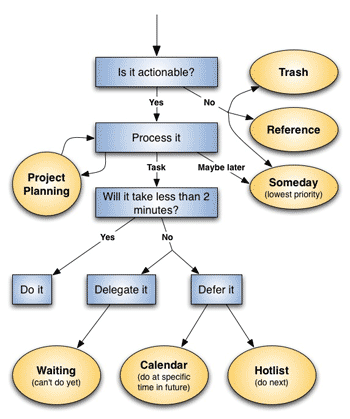
Surrounded by stacks of papers? GTD can help.
  • Next Actions : Get rid of abstract todo items that invite procrastination, and replace them with projects and concrete Next Actions. Probably the most powerful concept in the GTD system. 
  • Inbox to zero : Process email instead of just reading it, and always strive to get your inbox to empty. Create a separate action folder for things that require more time, and check that regularly.
  • Simple filing system: Create a new folder even if you only have 1 item to put into it, get rid of hanging file folders and categories, alphabetize everything, and use a nice label maker so you can find things. Because if it takes you more than a few seconds to file something, you won't do it. 
  • 2 minute rule : If it can be done in less than 2 minutes, do it now. 

6.  The Single System: I was only recently introduced to this in a great book called "Demystifying dissertation writing," but I wish I had read it my first year. This is particularly helpful for those with fear of the blank page, or those who struggle with writing lit reviews. It provides a logical system for getting through your readings, taking notes, and turning it all into a coherent final product.

7.  The DissCo: If you're like me, you thrive on variety, a fast-paced work environment, and teamwork. In which case...I'm sorry. Because that is not what grad school is about. It's a long and sometimes lonely road, especially when it comes to the major PhD hurdles: thesis, comprehensive/qualifying exams, and dissertation. Though these are ultimately hurdles you have to jump yourself, you can still create a sense of teamwork and community by meeting with other students.  I do this with others, and we call it The DissCo - for Thesis Dissertation and Comps. You can schedule regular times to meet and include goal setting and reviews, or just meet informally and work side by side. Because what sounds better -  "I'm going to sit next to people while staring at my laptop for 9 hours" or "I'm going to The DissCo"?

Of course, no technique will help you if you're not sure why you're in school, if you're too distracted by other pursuits to make it a priority, or if you're not willing to put in countless hours of hard work. But if these conditions are met, productivity tools and techniques can make life and work way easier. I'm sure there are tons of other suggestions that other people have - including current grad students and those who've survived it - so please share them in the comments!


Gina Cardazone, M.A.
University of Hawai`i, Mānoa


Wednesday, October 17, 2012

Communal Thriving: Pursuing Meaning, Justice, and Well Being

How can we help communities thrive? This is the question being addressed by the The Society for Community Research and Action (SCRA), which will be holding its 14th Biennial Conference next summer in Miami.

Want to know more about this topic, or have something to share with others? SCRA will be accepting proposals for sessions starting at the end of this month, and continuing through December 10th.

Proposals that emphasize participatory processes for sharing their ideas will be favored. There are six tracks, which are focused on communal thriving through:


  1. Community partnerships and social change
  2. Prevention and wellness promotion 
  3. Narrative, arts, and new media
  4. Equity, diversity, and social justice
  5. Research 
  6. Organizational and school transformation 


To submit a proposal, please visit http://www.scra27.org/biennial and select the “submit your proposal” link and follow the instructions. The All-Academic system will be ready to accept proposals on or about October 30th, 2012. The deadline for receipt of program proposals is: 11:55 PM (EST), Monday December 10th, 2012.


Tuesday, October 9, 2012

Collaborating for Justice: Disproportionate Minority Contact and Community Psychology

Minority youth, specifically African American and Latino/Hispanic males, have historically been overrepresented at every stage of the U.S. criminal justice system (Piquero, 2008). For these youth, initial contact can lead to transitions from one correctional institution to another and diminish their ability to contribute to their community and society in healthy ways.  These trends have led to what the Department of Juvenile Justice and Delinquency Prevention calls “disproportionate minority contact (DMC).”  Numerous points of interaction across the ecological context can directly and indirectly affect DMC, from the family, neighborhood, school, and institutional level.

Among the most valued principles of community psychology are promoting systems change and social justice. Using these principles and responding to DMC, the Center for Community Safety at Winston-Salem State University is fostering collaboration among key stakeholders and researchers to address DMC in North Carolina. Under the direction of Alvin Atkinson, Executive Director, the Center is undertaking two forms of action: 1) leading a research team to examine contributing factors to DMC and identify areas of need across youth services; and 2) organizing key stakeholders from agencies (i.e., Department of Social Services and juvenile detention centers) and institutions (i.e., law enforcement and public school system) throughout Forsyth County to engage in dialogue and develop an action plan to address DMC. 
The process of engaging stakeholders was a daunting task and required some push from the national and state level; nonetheless, it provided the leverage needed to get stakeholders talking about the issue.  According to Mr. Atkinson:

“Initially, the DMC stakeholders were identified and assembled by a different agency that had received funding to address the issue. The Center was the research partner for this collaborative and our 2006 report on DMC in Forsyth County solidified our role on this issue. When the funded ended, we stepped up to serve as the coordinating agency for Forsyth DMC efforts. We did this with the hope that the committee and our community would pursue some of the recommendations in the report.  Our initial efforts did not gain any traction locally, but did on the state and national levels. For the next few years, we used our work at the state level to keep the issue alive locally but did not invest heavily in reconvening stakeholders until the end of 2010 when we were ready to bring our knowledge and experience from our state and national involvement to Forsyth County. Since most of the stakeholders were familiar with our earlier work and having heard about our DMC work in the state, we were able to reconvene the group.”

The Center for Community Safety was established in 2001 to “engage communities in the strategic utilization of research to shape action and enhance response to community safety issues” (Center for Community Safety, 2012). The Center has been integral to Forsyth County and North Carolina by providing research, training, and technical assistance to build capacity among organizations that address violence prevention and intervention.  As a result, the Center would expand the university’s connection with “external constituencies and communities to respond to community-identified needs” (Harvey, Mac-Thompson, & Easterling, 2003).
Historically the Center has served more as a facilitator within the community; however, through DMC, the Center is utilizing research and analytic strategies to bridge the connection between research and action. Mr. Atkinson believes that, “With DMC, our research contribution is valued and it also provides a service to the community.” 

Through the support of the Governors Crime Commission and Department of Juvenile Justice and Delinquency Prevention, the Center is currently conducting a state-wide mixed methods study of DMC to assess the point where DMC is most prevalent across initial referrals to detainment and areas where there exist the greatest need to address youth and family services.  According to Mr. Atkinson, the intent of this work is to “seek to improve collaborative research efforts and regain the confidence and trust of the stakeholders.” Ultimately, the findings seek to support advocacy efforts by local leaders in promoting positive youth and community development and addressing systems’ change. 
Through the leadership of Mr. Atkinson and collaboration between community stakeholders and researchers from Winston-Salem State University, the goals of this endeavor are manifold. However, the Center is striving to become a relevant participant in facilitating systems change by advocating for strategies and initiatives that reduce the number of minority youth involved in the criminal justice system.

Dawn Henderson 
North Carolina State University 

______________________________________________________________


References:

Harvey, L., Mac-Tompson, D., & Easterling, D. (2003). A blueprint for sustaining community-based initiatives: A case study of the Center for Community Safety at Winston-Salem State University. A report submitted to the National Institute of Justice.

Piquero, A. R. (2008). Disproportionate Minority Contact. Retrieved on September 21, 2012 from http://www.futureofchildren.org/futureofchildren/publications/docs/18_02_04.pdf

For more information about the Center for Community Safety, see http://centerforcommunitysafety.org/

For more information about Disproportionate Minority Contact, see http://www.ojjdp.gov/dmc/

This is a part of a series of bulletins highlighting the use of community psychology in practice.  For more information about the series, contact Bill Berkowitz at Bill_Berkowitz@uml.edu

Tuesday, October 2, 2012

Are You Registered to Vote? Deadlines are Approaching!

I have a dream...of a day when registering to vote in the U.S. and figuring out basic information about voting is as simple and easy as booking a cross country flight, sharing your opinions with hundreds of friends, or instantaneously accessing ancient religious texts.


In an age of mind-blowing technological advances and an explosion of information sharing, in a country that often claims a large share of credit for these advances, you'd think that we'd be ahead of the game in enabling this most fundamental act of democratic participation. On the contrary, plenty of folks are seemingly outraged that there aren't even more barriers in place. 

But this is not a post about voter ID laws. This is about you, dear U.S. readers, and whether or not you're registered to vote. Because a functioning democracy requires full participation. And because voter registration deadlines are rapidly approaching. And while it's still not quite iPad-easy, there are plenty of organizations using technology to make the registration and voting process a whole lot easier. 

The League of Young Voters* has a list of resources designed to make the process easier, including: 

  • TurboVote - Here you can enter your information, print out your registration form, and mail it in. In earlier days, they would have even mailed it for you, but since registration deadlines are so soon, you've got to take that last step yourself. 
  • TheBallot.org - A promising attempt to create a forum that provides information on what's on your ballot, and allows people to share their intended ballots online. 
  • Student Voting Guide - This state-by-state clickable map has information on voter registration rules and student voter rights, developed by the Brennan Center for Justice at NYU School of Law. 
  • 1-866-OUR-VOTE (English) or 1-888-Ve-Y-Vota(Spanish). Use the old fashioned telephone to find answers on voter registration and polling places, and to report voting problems. (You can also go to 866OurVote.org)

All this is not to say that voting is a terribly a complicated thing. You register, you (hopefully) research the candidates and issues that are being voted on in your state, you mail in your ballot or show up on Election Day, and voila, you are an active participant in democracy! Sure, it could be easier, but especially with all these resources, there's really no excuse not to do it. Our forefathers and especially our foremothers fought long and hard for the right to do it, so let's not let lack of time or a stamp get in our way. 

Gina Cardazone
University of Hawaii at Manoa

*Historical sidenote: When I was first introduced to the League of Young Voters in the early 2000's, it was called the League of Pissed Off Voters. Incidentally, at this time I was both younger and more pissed off. 

Wednesday, September 26, 2012

Better Outcomes for Substance Abuse Addiction: Spotlight on Leonard Jason and the Oxford Houses

Alcohol and drug addiction is a complex and pervasive chronic condition that causes substantial harm, not only to individuals suffering from addiction, but also to those around them. Recognizing the importance of understanding this complex condition, a team of Chicago-based community psychologists, led by Dr. Leonard Jason of DePaul University, has focused its efforts on studying recovery outcomes for those in recovery from addiction. 

Oxford House: Self-Help for Sobriety without Relapse
At a young age, Dr. Jason discovered the atrocities of the Holocaust, and this knowledge motivated him to work for social change. He understood that most community changes are not brought about by authority figures such as politicians, but by ordinary members of the community. After learning about the Oxford House model, he recognized it as a prime example of individuals successfully using the support of their communities to overcome their difficulties. For over 20 years, Dr. Jason and his team have been researching the role that Oxford Houses play in substance abuse recovery.

Oxford Houses (OH) are self-governing recovery homes that are rented by six to ten people who are in recovery from alcohol or drug addiction. Oxford Houses are run democratically, require residents to pay an equal share of rent and expenses, and have a zero tolerance policy toward alcohol and drug use. What makes OH’s distinct from similar institutions is that there are no residency time limits, something that current addiction research deems very important, as there is no universal timeline for a successful recovery process. 
For years, the results of Dr. Jason’s research have provided food for thought to many who are interested in addiction and recovery within the scientific community. Through a number of multi-million dollar grants from the National Institute of Health, Dr. Jason and his team have empirically validated the positive effects of Oxford House residency when compared to usual care facilities, such as higher abstinence rates (69% vs. 35%), higher monthly income ($989 vs. $440), and lower incarceration rates (3% vs. 9%). These findings led the Substance Abuse and Mental Health Administration (SAMSHA) to recognize the OH model as a successful recovery model and also resulted in the reinstatement of Illinois’s revolving fund to help open new houses, among other benefits. Outside of academic publications, descriptions of Dr. Jason’s past and current research are systematically distributed at the Oxford House conferences.

Ed Stevens, a graduate student in DePaul’s doctoral Community Psychology program, believes that the team’s research answers three very important questions about the OH model:   1) Does it work? 2) Can it be replicated? and 3) Can its elements be used for other systems? Ed calls OH a “grassroots model” and a “classic form of empowerment” in which people are trying to solve their own problems and overcome their own obstacles. Olya Belyaev-Glantsman, a doctoral student in DePaul’s Community Psychology program who has worked with Dr. Jason since 2001, states, “It feels great knowing that thousands of lives are positively affected by Dr. Jason’s work.”  Ed Stevens adds, “I love the topic. I love people we are involved with; it’s an honor to work with them.” 

The feedback from Oxford House representatives on their experience working with the DePaul University research team is also overwhelmingly positive. For example, when asked about his involvement with the OH research team, Rory, a state coordinator and an Oxford House resident for seven years, said that it makes him feel good to be a part of this team, and that he is glad the team sought his help. “After being part of a problem for so long, I feel like I am now part of the solution,” he continued. Rory has been working with DePaul’s team for three years, helping with recruiting, tracking, and placing individuals into Oxford Houses. He also holds another important role – through his own experience, as well as his active involvement with Oxford House, Inc., he helps the team to better understand the addiction and the recovery process. Rory laughs when he reflects on his first experience at the team’s weekly meeting: “[Coming in with no research skills,] at first I was lost,” but over the years he has become comfortable interpreting data and is often the one the team turns to when it needs help explaining the results of its studies.

The topic of recovery is extremely important and through this truly collaborative partnership, the Oxford House Inc. and the DePaul’s research team are constantly sharing resources and learning from each other on the road to better outcomes for substance abuse addiction. The years of systematic research by Dr. Jason’s team helped raise awareness of this successful and cost effective recovery approach.

Olya Belyav-Glantsman
 DePaul University 

______________________________
For more information about Oxford House Inc., see http://www.oxfordhouse.org/userfiles/file/

For more information on Dr. Jason’s work, see http://condor.depaul.edu/ljason/

To see Dr. Jason talking about OH, see http://www.youtube.com/watch?v=15lIOw1VVCw

This is the second in a series of bulletins highlighting the use of community psychology in practice, written by the members of the Outreach Group of the Community Psychology Practice Council. For more information about the series, contact Bill Berkowitz at Bill_Berkowitz@uml.edu.  

Monday, September 17, 2012

Up to $1200 for your Community Project! Applications are Open for the 2012 SCRA Mini-Grants

Free money for my community? Why, sure!
Welcome back to the SCRA blog! We're happy to be back after a busy summer, and have great news - the second round of SCRA Community Mini-Grants are now available!

The SCRA Community Mini-Grant  
Who Can Apply:  Current SCRA members, along with their community/organizational partners
What:  Funding (up to $1,200) for small, time-sensitive, community-based projects; up to ten awards available annually.  Grant criteria include timeliness, potential for success/impact, community involvement, and alignment with SCRA’s vision, mission and values.  Grantees must be willing to share the process and outcome of their funded actions with others. 
Where:  Communities across the globe.
When:  Completed pre-application forms are accepted on a rolling basis.
Why:  Because SCRA wants to help communities in “real-time” and recognizes that a small amount of funding can often make a meaningful difference. 
How:  Find the application online at  www.scra27.org/communityminigrants.  Pre-Application forms will be reviewed within a week to ten days of submission, at which point some applicants will be invited to fill out the longer, 3-page application form for funding.  All pre-applications and applications will be subject to a blind-review process.

The Community Mini-Grant is generously funded by SCRA and administered by the Practice Council.   
Questions? Clarifications? Email: SCRACommunityGrants@gmail.com

***At least one person associated with each application must be a current SCRA member.  Additionally, the Mini-Grant funds cannot be used to support projects that are already being financially supported by SCRA (e.g., through the Policy Grant or various student research grants).***

Sunday, July 1, 2012

Community Psychologists: Boosters for the Local Economy

Every so often, it’s helpful to take a step back and realize how many intriguing community ideas are out there. Creative, feasible, and potentially powerful ideas. Tested and replicable ideas, ripe for the taking. And simple ideas – sometimes so simple that you might wonder, “Why didn’t I think of that?”
But with the Web, you needn’t think so hard; you mostly need to know where to find good ideas and put them to use. In other words, there are many available ways to do business in the community; both figuratively – or in the case of this blog post, literally.
For example: In this presidential year, where jobs and the economy are dominating issues, we might consider ideas community psychologists could apply to boost the local economy. I can mention three that recently crossed my path:
* Do you have a favorite local business? If so, you can get together with others to support it, in an organized way, by being part of a cash mob. Just mobilize your friends and neighbors, agree on a date and time, and show up at the store with cash in hand. Then simply spend money, hopefully on items of value to you. Cash mobs, a flash mob spinoff, have become something of a national phenomenon. More at www.cashmobs.com.
* No cash to spend? Then invent your own. Many of us have become familiar with homegrown currencies, such as Ithaca Hours, or BerkShares, in Massachusetts (www.ithacahours.com, and www.berkshares.org). Another very simple ideas was Downtown Dollars, in Ardmore, Pennsylvania, where merchants sold Downtown Dollars at a 50% discount to Ardmore area shoppers, who could then spend those dollars at local stores. See http://money.cnn.com/galleries/2012/pf/1201/gallery.community-currencies/7.html.
* Got a business idea? Then pitch it. In Grand Rapids, Michigan, five contestants had five minutes each to pitch their best business idea to a local jury, with prizes of up to $5000. One idea that caught my eye was a creating a “signature sandwich” for Grand Rapids, to put it on the culinary map. (See http://www.npr.org/2011/03/18/134930914/In-Michigan-Entrepreneurs-Pitch-Ideas-for-5-000.) Could you do something like that where you live?
These ideas just skim the surface, without yet touching on individual creative ideas some of your acquaintances have probably had. What an asset it would be to have a useful compendium of these and other community ideas – but that’s for another posting.
Can community psychologists be “job creators”? Not directly, as a rule.
We don’t hear much about our colleagues starting businesses – although they, and we, could. True, most of us may not aspire to become Captains of Industry, or even CEO’s; but we can surely support local businesses, encourage new ones, and apply our knowledge and skills to create a local economic climate where community psychology values will take hold and flourish. 

Bill Berkowitz
University of Massachusetts Lowell